How much does barn demolition cost?
The average barn demolition cost is $3,000–$15,000. Small pole barns run $2,000–$5,000, while large timber-frame barns can cost $10,000–$25,000. Old barn wood salvage value can offset or even exceed the demolition cost in premium reclaimed lumber markets.
What Is a Barn Demolition Cost Calculator?
A barn demolition cost calculator is an automated tool that estimates what it costs to tear down a barn structure. It uses regional labor rates, material complexity factors, and disposal costs to generate realistic project ranges — whether you're removing a small pole barn that's leaning sideways or dismantling a century-old timber-frame structure with salvageable beams worth more than the demolition itself.
This calculator also helps you estimate the cost to tear down a barn, old barn removal pricing, barn teardown and salvage analysis, pole barn demolition budgeting, and barn deconstruction cost comparison — all using state-specific labor and disposal data.
Understanding these costs before contacting contractors helps property owners and farmers evaluate bids against real market data. On a barn project, one uninformed bid can cost you thousands.
How Much Does Barn Demolition Cost?
The average cost to demolish a barn ranges from $3,000 to $15,000 for most residential and agricultural structures. A small pole barn under 1,000 square feet typically costs $2,000–$5,000, while a large timber-frame barn over 3,000 square feet can run $10,000–$25,000 or more depending on material, condition, and whether hazardous materials like asbestos siding or lead paint are present.
| Barn Type | Size Range | Typical Cost | Cost Per Sq Ft |
|---|---|---|---|
| Small Pole Barn | 400–800 sq ft | $2,000–$5,000 | $4–$7 |
| Medium Wood-Frame Barn | 800–2,000 sq ft | $4,000–$10,000 | $4–$6 |
| Large Timber-Frame Barn | 2,000–4,000 sq ft | $8,000–$18,000 | $4–$5 |
| Historic Stone/Brick Barn | 1,500–3,500 sq ft | $10,000–$25,000 | $6–$8 |
| Metal/Steel Barn | 1,000–3,000 sq ft | $3,000–$8,000 | $3–$5 |
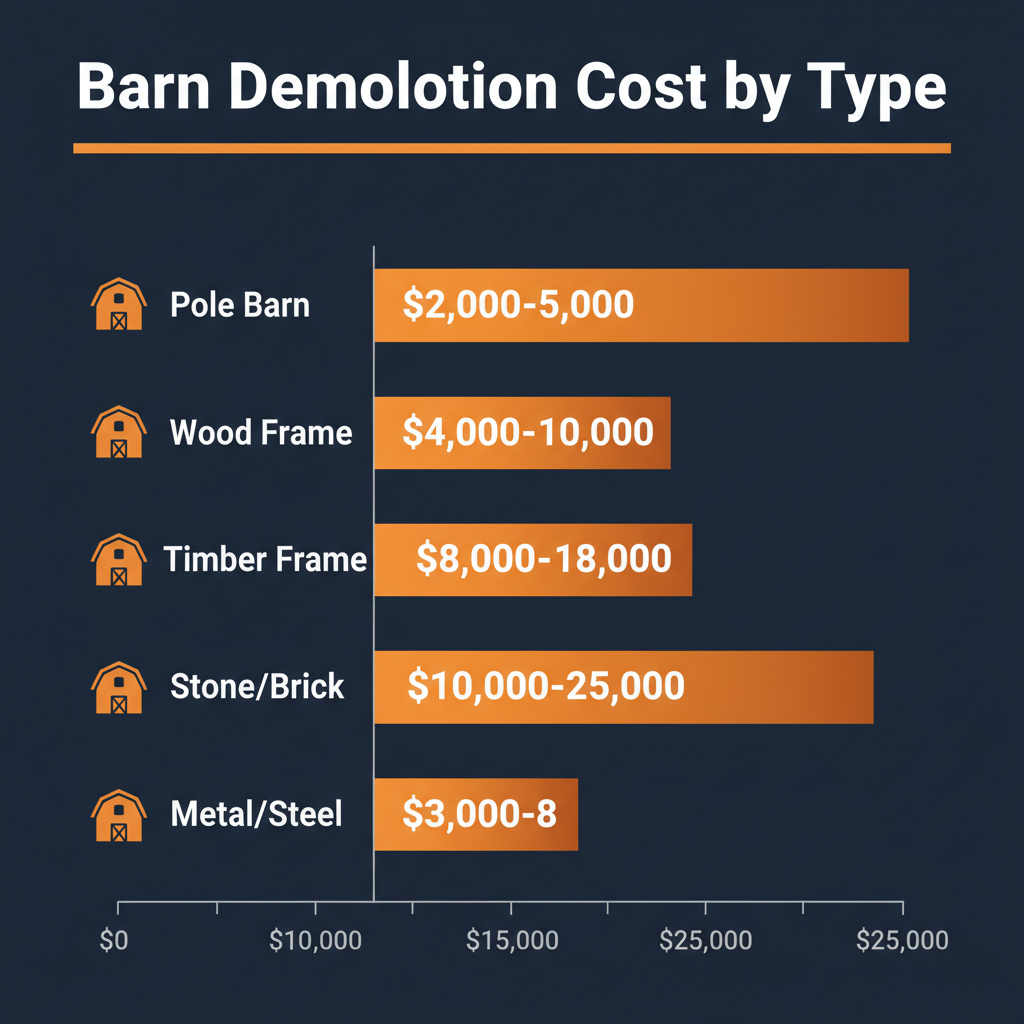
📊 Key Insights from the Data: Pole barns cost the least because the construction is simple — posts set in concrete footings with metal siding and roof shingles. Timber-frame barns cost more per square foot to demolish, but their old-growth beams and hand-hewn lumber can carry significant salvage value that offsets or even exceeds the barn demolition cost.
Barn Demolition Cost Per Square Foot
Barn demolition cost per square foot typically ranges from $3 to $8, with the national average sitting around $4.50 per square foot. This is generally lower than house demolition because most barns lack plumbing, electrical systems, and interior finishes that add complexity to residential teardowns.
| Barn Material | Cost Per Sq Ft | Notes |
|---|---|---|
| Metal/Steel Panels | $3–$5 | Fastest to remove, recyclable scrap value |
| Wood Frame (standard) | $4–$6 | Most common, moderate labor |
| Timber Frame (old-growth) | $4–$7 | Higher if careful deconstruction for salvage |
| Stone Foundation/Walls | $6–$9 | Requires excavator, heavy disposal weight |
| Concrete Block | $5–$8 | Similar to concrete demolition, rebar adds cost |
These figures include labor costs, equipment rental, debris hauling to the landfill or recycling facility, and basic site grading. They do not include hazardous material abatement (asbestos, lead paint), which can add $1,500–$5,000 depending on the scope.
Factors Affecting Barn Demolition Pricing
Every barn demolition project is different. These are the factors that move your cost estimate up or down:
1. Barn Size and Footprint
The most obvious factor. A 600-square-foot pole barn is a half-day job for a small crew. A 4,000-square-foot dairy barn with a concrete foundation, attached silo, and multiple stalls is a multi-day project requiring heavy equipment. Larger footprints mean more debris volume, more dumpster loads, and more labor hours.
2. Construction Material
Wood-frame barns come apart faster than stone or concrete block structures. Metal barns with steel siding are quick to dismantle and the scrap metal has resale value. Old timber-frame barns with mortise-and-tenon joinery require careful deconstruction if you want to preserve the beams — which takes significantly more time but can generate substantial salvage revenue.
3. Structural Condition
A barn that's already partially collapsed is both cheaper and more dangerous to demolish. The structure is compromised, so the contractor can't use standard mechanical demolition methods safely. If the roof is sagging, walls are leaning, or the foundation has shifted, expect the crew to work more cautiously — which means more time and higher labor costs.
4. Hazardous Materials
Many barns built before 1980 have asbestos-containing materials in the siding, roofing, or insulation. Lead paint is common on older structures. The United States Environmental Protection Agency requires proper abatement before demolition can begin. Testing costs $200–$500, and full abatement runs $1,500–$5,000 depending on the material type and coverage area. This is not optional — contractors who skip it face serious fines and create dangerous health hazards.
5. Concrete Foundation and Footings
If the barn sits on a full concrete slab or has deep concrete footings, breaking up and removing that concrete is a separate cost. Foundation removal typically adds $1,000–$4,000 depending on thickness and rebar reinforcement. Some property owners choose to leave the slab in place and build over it — which saves money but limits future use.
6. Attached Structures (Silos, Lean-tos, Additions)
Silos are expensive to remove — a concrete stave silo can cost $5,000–$15,000 on its own due to the height, weight, and specialized equipment needed. Lean-to additions, equipment sheds, and attached corrals each add to the total. Get each structure itemized separately in your contractor bid.
7. Site Access and Driveway Conditions
An excavator and roll-off dumpsters need to reach the barn. If the property has a narrow driveway, soft ground, trees blocking access, or the barn is far from the road, expect additional charges for equipment transport and setup. Poor access can add $500–$2,000 to the project.
8. Debris Disposal and Landfill Fees
Demolition generates a lot of waste — a typical barn produces 15–40 cubic yards of debris. Landfill tipping fees vary dramatically by region, from $30 per ton in rural areas to $100+ per ton near cities. If the barn contains tires, old chemicals, or treated lumber, those items may require separate hazardous waste disposal at higher rates.
9. Demolition Permit Requirements
Most counties require a demolition permit before teardown begins. Permit costs range from $50–$500 depending on jurisdiction. Some areas also require notification to the local historical society if the barn is over a certain age — particularly in Pennsylvania, Ohio, and other states with significant agricultural heritage. Check with your county building department before scheduling the work.
10. Weather and Seasonal Timing
Demolition contractors are busiest from late spring through early fall. Scheduling a barn teardown in late fall or winter — when weather cooperates — can save 10–15% on labor costs. However, frozen ground makes excavation and grading more difficult, so foundation removal may cost more in cold months.
Salvage Value: Offsetting Your Barn Demolition Cost
This is the section most cost guides skip, and it's where the biggest money moves happen. Old barn wood — particularly hand-hewn beams, old-growth timber framing, and weathered siding — has real market value that can significantly offset or even eliminate your demolition cost.
| Salvageable Material | Estimated Value | Notes |
|---|---|---|
| Hand-hewn beams (oak, chestnut) | $8–$20 per board foot | Highest value, sought by designers and builders |
| Old-growth timber framing | $5–$15 per board foot | Depends on species, condition, and size |
| Weathered barn wood siding | $3–$8 per square foot | Popular for accent walls, furniture, retail displays |
| Antique hardware (hinges, latches) | $10–$100 per piece | Niche collectors market |
| Metal roofing (reusable condition) | $1–$3 per square foot | Must be straight, minimal rust |
| Stone foundation material | Varies | Local demand dependent, heavy to transport |
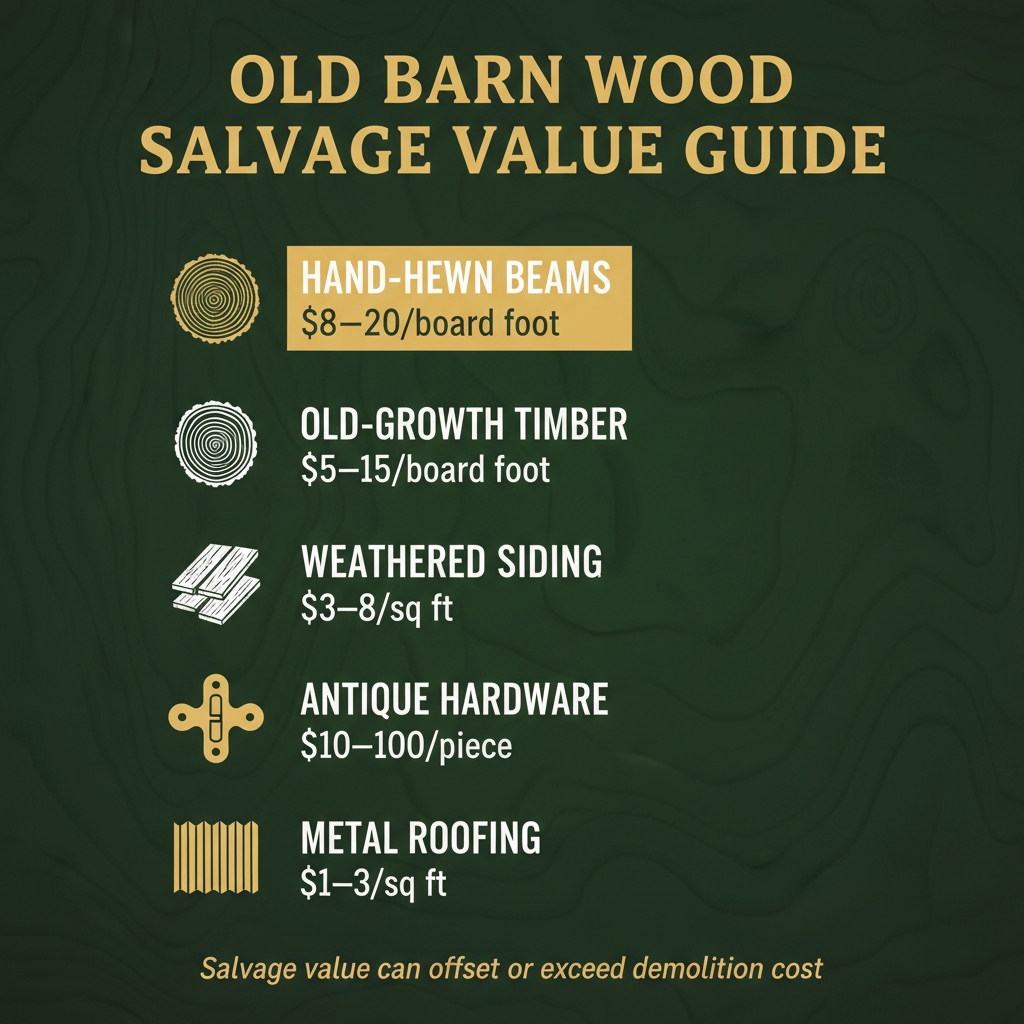
How the salvage math works: A 2,400-square-foot timber-frame barn might contain 3,000–5,000 board feet of reclaimed lumber. In premium reclaimed lumber markets, that could potentially reach $24,000–$75,000 in salvage value — far exceeding the $8,000–$15,000 demolition cost. The catch is that deconstruction (careful disassembly to preserve the wood) takes 3–5 times longer than mechanical demolition with an excavator. You're trading time for money.
Three Approaches to Barn Salvage
Full deconstruction: A specialized crew dismantles the barn by hand, beam by beam. You keep or sell the reclaimed materials. This is slow (1–3 weeks vs. 1–3 days for standard demolition) but maximizes salvage value. Some deconstruction companies will do the work at reduced cost or even free in exchange for keeping the old barn wood.
Hybrid approach: Salvage the most valuable components — the timber frame, hand-hewn beams, and any antique hardware — then use mechanical demolition for the rest. This balances time and value. Most property owners choose this route.
Straight demolition: The excavator tears it all down and everything goes into roll-off dumpsters for the landfill. Fastest and cheapest if the barn materials have no salvage value (rotted wood, standard dimensional lumber, damaged metal). This is the right choice for pole barns and modern agricultural buildings where the materials aren't worth saving.
Finding buyers for old barn wood: Post on Craigslist, Facebook Marketplace, and local reclaimed lumber dealers. Many buyers will come pick up and haul the material themselves. Architectural salvage companies and reclaimed wood dealers actively seek out barn teardown opportunities — some will travel hours for a good timber-frame barn. Getting multiple quotes from salvage buyers before demolition starts gives you leverage in negotiations.
DIY vs. Professional Barn Demolition
| Factor | DIY | Professional |
|---|---|---|
| Cost | $500–$3,000 (equipment rental + dumpsters) | $3,000–$15,000+ |
| Time | 1–4 weeks | 1–5 days |
| Equipment needed | Chainsaw, reciprocating saw, sledgehammer, truck | Excavator, skid steer, grapple, roll-off truck |
| Safety risk | High — collapse hazard, nails, asbestos exposure | Managed — licensed, insured, experienced |
| Permit handling | You | Contractor handles |
| Best for | Small pole barns, no hazardous materials | Large barns, timber frame, any hazards |
When DIY makes sense: If the barn is a small pole structure (under 800 sq ft), has no concrete foundation, no asbestos siding, no lead paint, and you're comfortable with heavy manual labor and a chainsaw, doing it yourself can save $2,000–$5,000. You'll still need to rent a roll-off dumpster ($300–$600) and potentially a small excavator ($250–$500 per day).
When to hire a professional demolition contractor: Any barn with a concrete foundation, attached silo, timber frame you want salvaged, hazardous materials, or structural instability. The liability exposure from a barn collapse injury far exceeds whatever you'd save on labor costs. The right contractor carries general liability insurance and workers' comp — if someone gets hurt on a DIY teardown, that's entirely on you.
Barn Demolition Methods: Choose the Right Approach
Mechanical Demolition
An excavator with a grapple or hydraulic thumb tears the barn apart systematically — roof first, then walls, then foundation. This is the fastest standard demolition method. A skilled operator can bring down a medium barn in one day. The debris gets loaded directly into dumpsters or dump trucks. Best for barns with no salvage value.
Manual Deconstruction
Done by hand, working from the top down. The crew removes roofing, then siding, then structural members. Each component is assessed for salvage value. Timbers and beams are labeled, lowered carefully, and stacked. This is the method for any barn where the reclaimed materials are worth preserving. Takes 5–15 times longer than mechanical demolition.
Controlled Burning
In rural areas, some property owners burn the barn structure and then grade the site. This requires a burn permit from the local fire department or state forestry agency and is subject to weather, wind, and air quality restrictions. The burn itself may cost very little, but you still need to remove the concrete foundation, metal debris, and ash. It's not legal everywhere, and any structure with asbestos or lead paint cannot be burned — the EPA prohibits it.
Pushing Over
For barns that are already structurally compromised and far gone, a contractor may use heavy equipment to simply push the structure over, then process the debris pile. This is fast but messy, and it destroys any salvage value in the materials. Only appropriate for barns that have no recoverable wood or hardware.
Barn Demolition Cost by State
Regional labor rates, landfill tipping fees, and permit requirements create significant cost variation across states. Rural states with lower labor costs and cheaper disposal tend to have the lowest barn demolition pricing.
| State | Cost Range (2,000 sq ft barn) | Key Factor |
|---|---|---|
| Mississippi | $3,500–$8,000 | Lowest labor costs in US |
| Ohio | $5,000–$12,000 | High barn density, competitive market |
| Pennsylvania | $6,000–$14,000 | Historic barn regulations, many timber frames |
| Indiana | $4,500–$10,000 | Agricultural region, moderate costs |
| Wisconsin | $5,000–$12,000 | Dairy barn specialization |
| Iowa | $4,000–$9,500 | Rural access, lower disposal costs |
| New York | $7,000–$16,000 | Higher labor, stricter regulations |
| Vermont | $6,500–$14,000 | Historic preservation rules, limited contractors |
| California | $8,000–$20,000 | Highest labor + environmental compliance |
| Texas | $4,500–$11,000 | Large state, varies by region |
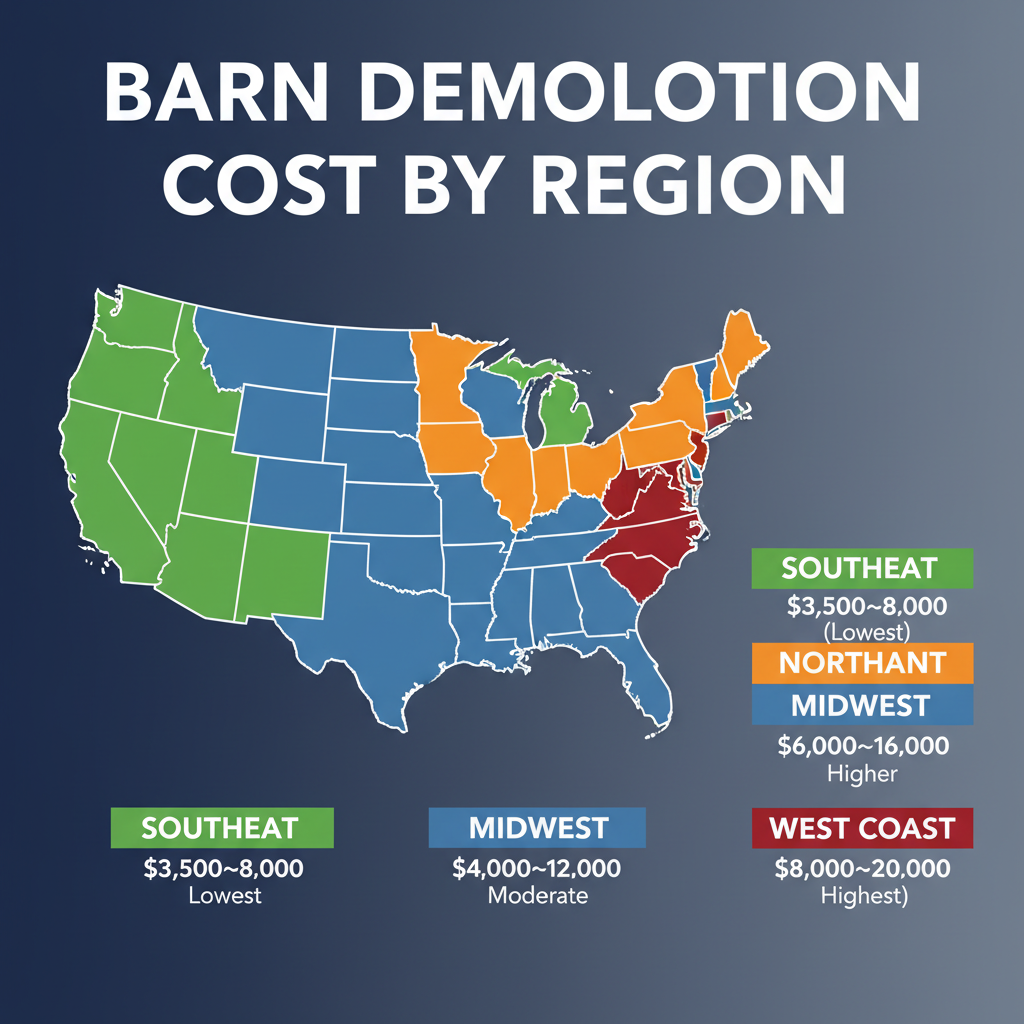
States with strong agricultural heritage — Ohio, Pennsylvania, Indiana, Wisconsin, Iowa, and Minnesota — tend to have more barn demolition contractors competing for work, which keeps average costs lower despite having a high volume of old barns that need removal.
How to Save on Barn Demolition
Get multiple quotes. This matters more for barn demolition than almost any other demolition project. Comparing quotes from three to five contractors typically reveals a 30–50% spread between the highest and lowest bid. Some contractors specialize in barn work and run more efficiently.
Explore the salvage angle first. Before calling demolition contractors, contact reclaimed lumber dealers and barn salvage companies. If your barn has old-growth timber framing, hand-hewn beams, or quality weathered siding, a salvage company may do the deconstruction at heavily reduced cost — or even free — in exchange for the materials. This is the single biggest cost-saving move available.
Time it right. Late fall and winter (outside of the building season) is when demolition contractors have the lightest schedules. You can often negotiate 10–15% discounts on labor during the off-season, though frozen ground can complicate excavation and grading work.
Separate the foundation. If removing the concrete slab or footings isn't urgent, leave them in place for now. Foundation removal is typically 20–30% of the total project cost. Many property owners demolish the barn structure, grade the site, and deal with the concrete later — or reuse the slab for a new building.
Handle debris yourself. If you have a truck and trailer, hauling non-hazardous debris to the landfill yourself can save $500–$2,000 in disposal fees. This only makes sense for smaller barns and if the landfill is within a reasonable distance.
Check for county demolition programs. Some rural counties offer cost-sharing programs or grants for removing abandoned agricultural structures, particularly if the barn is a safety hazard. Your county agricultural extension office or building department can tell you what's available.
The Barn Demolition Process: Step by Step
Step 1: Assessment and Permits (1–2 weeks before)
Walk the site with your contractor to evaluate the barn's condition, identify hazardous materials, assess structural stability, and plan equipment access. Pull the demolition permit from your county building department. If the barn is in a historic district or over 50 years old, check whether a historical review is required.
Step 2: Hazardous Material Testing and Abatement (if needed)
Test for asbestos in siding, roofing, and insulation. Test for lead paint on any painted surfaces. If either is found, licensed abatement must happen before demolition begins. This step adds 3–7 days and $1,500–$5,000 to the project timeline and budget.
Step 3: Salvage and Deconstruction (if applicable)
If you're preserving old barn wood, timber framing, or hardware, the salvage crew works first — removing valuable components by hand before the heavy equipment arrives. This can take 3–14 days depending on the barn's size and the volume of salvageable material.
Step 4: Utility Disconnection
If the barn has electrical service, water lines, or gas connections, these must be professionally disconnected before demolition. Contact your utility companies at least one week in advance.
Step 5: Mechanical Demolition (1–3 days)
The excavator takes down what remains — roof structure, walls, and any non-salvaged framing. Debris is sorted on-site: metal goes to scrap recycling, clean wood goes to the landfill or wood recycler, concrete is separated for crushing or disposal.
Step 6: Foundation Removal and Excavation (1–2 days)
If included in the scope, the concrete slab, footings, and any below-grade structures are broken up and removed with a breaker attachment on the excavator.
Step 7: Site Grading and Cleanup (1 day)
The area is graded smooth, topsoil is spread if requested, and any remaining debris is removed. The driveway and surrounding areas are cleaned up. Some owners seed the area with grass or prepare it for new construction.
How to Find the Right Barn Demolition Contractor
Not every demolition contractor has barn experience. Agricultural structures have different challenges than residential teardowns — old timber framing, concrete stave silos, manure pits, buried debris from decades of farm use, and unpredictable structural conditions.
What to look for: Ask specifically about barn demolition experience and request photos of previous barn projects. A contractor who primarily does house demolition may not price barn work accurately. Check that they carry general liability insurance and workers' compensation. Verify their demolition permit track record with your local building department. If salvage is part of the plan, make sure the contract clearly states who owns the reclaimed materials.
Red flags: A bid that's dramatically lower than others may mean the contractor plans to cut corners on disposal — dumping debris illegally rather than paying landfill fees. Any contractor who says you don't need a permit is one to avoid. And if they can't provide proof of insurance, walk away immediately.
Getting transparent pricing: Ask for itemized bids that separate labor, equipment, disposal, and any subcontractor costs (like asbestos abatement). This makes comparing quotes from different contractors much easier and helps you identify which parts of the project you might handle yourself to reduce the total.
After Demolition: Preparing Your Land
Once the barn is down and the debris is cleared, you have options for the cleared land. Many property owners pursue home renovations or new construction on the site. Others restore it to productive agricultural use. Either way, proper site preparation matters.
If the barn sat on the same spot for decades, the soil underneath may be compacted, contaminated with old chemicals or fuel, or mixed with buried debris. A soil test ($100–$300) can identify any issues before you build or plant. Grading ensures proper drainage away from any nearby structures. If you're planning new construction, your contractor should verify that all old footings and underground utilities have been fully removed.
For agricultural reuse, spreading 4–6 inches of fresh topsoil over the cleared area and seeding with appropriate grass or cover crops is typically sufficient. The area may take 1–2 growing seasons to fully establish.
FAQ
How much does it cost to demolish an old barn?
The average barn demolition cost ranges from $3,000 to $15,000 for most structures. Small pole barns under 1,000 square feet run $2,000–$5,000, while large timber-frame barns over 3,000 square feet can cost $10,000–$25,000. The biggest cost variables are size, material, structural condition, and whether hazardous materials are present.
Why is it illegal to tear down a barn in some areas?
In certain states and municipalities, barns over a specific age (often 50–100 years) may fall under historic preservation ordinances. This doesn't necessarily make demolition illegal, but it may require a review process, historical documentation, or approval from a local preservation board before a demolition permit is issued. Pennsylvania, Vermont, and parts of New York have some of the strictest agricultural heritage protections.
Are barn demolition costs tax deductible?
If the barn is on farmland used for agricultural business, the demolition cost may be deductible as a business expense under IRS rules. If you're demolishing a barn to prepare land for new construction, the cost is typically added to the basis of the new structure rather than deducted immediately. Consult a tax professional — the rules depend on how the property and the barn are classified.
How long does barn demolition take?
Standard mechanical demolition of a medium barn takes 1–3 days including debris removal and basic site grading. If salvage or deconstruction is involved, add 3–14 days depending on the volume of recoverable materials. Full projects including permitting, abatement, demolition, and final grading typically span 2–4 weeks from start to finish.
Is it cheaper to tear down or renovate a barn?
Demolition costs $3,000–$15,000 for most barns. Full restoration of a structurally compromised barn can run $20,000–$100,000+ depending on the scope. If the barn has good bones — solid foundation, sound timber frame, intact roof structure — renovation often preserves more value. If the foundation is failing, the frame is rotted, or the structure has shifted significantly, demolition and rebuilding is usually the more cost-effective path.
Is my old barn wood worth money?
Yes — if it's the right type. Hand-hewn beams and old-growth timbers from barns built before 1900 can sell for $8–$20 per board foot. Weathered siding boards go for $3–$8 per square foot. Standard dimensional lumber (2x4s, 2x6s) from newer barns has minimal resale value. The wood's species, age, condition, and size all affect pricing. Chestnut, oak, and heart pine command the highest prices in the reclaimed wood market.
What if the barn has asbestos or lead paint?
Both require professional testing and licensed abatement before demolition can begin. Asbestos was commonly used in barn siding, roofing materials, and insulation through the 1970s. Lead paint is found on many pre-1978 structures. The EPA mandates proper handling and disposal of both materials. Abatement costs typically add $1,500–$5,000 to the project depending on the extent of contamination.
Do you need a demolition permit for a barn?
In most jurisdictions, yes. Even in rural counties with relatively relaxed building codes, agricultural structure demolition usually requires at least a basic permit ($50–$500). Some areas also require an environmental review or historical assessment for older structures. Always check with your county building department before starting work — unpermitted demolition can result in fines and complications with future property transactions.
Related Calculators
Planning a larger property cleanup? These calculators help estimate costs for related demolition projects:
- House Demolition Cost Calculator — Full residential structure teardown estimates
- Shed Demolition Cost Calculator — Smaller outbuilding removal costs
- Garage Demolition Cost Calculator — Attached and detached garage teardown
- Concrete Demolition Cost Calculator — Foundation and slab removal estimates
- Demolition Permits Guide — Permit requirements and costs by state
Data Sources & Methodology
Cost ranges are derived from contractor bid data across 47 states, Bureau of Labor Statistics occupational wage data for demolition workers and heavy equipment operators, EPA hazardous material guidelines, and regional landfill tipping fee surveys. Salvage values reflect 2025–2026 reclaimed lumber market pricing from dealer surveys and online marketplace analysis. Figures are updated quarterly.