What Is a Demolition Permit?
A demolition permit is a formal approval issued by your local building department that authorizes the partial or complete teardown of a structure. It exists to ensure the demolition is done safely, that hazardous materials like asbestos are properly handled, that utilities are disconnected, and that the work meets local building code requirements.
Every type of demolition project — from tearing down a house to removing a barn, garage, or pool — typically requires a permit before work begins. The permit fee is separate from the demolition cost itself and is paid directly to your city or county building department.
Skipping the permit is one of the most expensive mistakes property owners make. Unpermitted demolition can trigger fines, stop-work orders, and complications that cost far more than the permit fee itself.
How Much Does a Demolition Permit Cost?
Demolition permit fees vary dramatically by location — from as low as $25 in rural areas to over $1,000 in major cities. The national average for a residential demolition permit falls between $100 and $400.
| Permit Type | Fee Range | National Average | Processing Time |
|---|---|---|---|
| Residential Demolition | $25–$1,000 | $100–$400 | 3–14 business days |
| Commercial Demolition | $200–$5,000+ | $500–$2,000 | 10–30 business days |
| Partial / Interior Demo | $25–$500 | $75–$200 | 3–10 business days |
| Historic District Demo | $100–$2,000+ | $300–$800 | 30–90+ business days |
The actual cost depends on several factors: your state and municipality, the size and type of structure being demolished, whether it's residential or commercial, and whether the property is in a historic district or has special zoning classifications.
What's Included in the Permit Fee
The demolition permit fee typically covers the application review process, one or two site inspections (pre-demolition and post-demolition), and the administrative cost of processing your application. It does not include the cost of required documentation you may need to submit, such as an asbestos survey ($200–$500), structural engineering assessment ($300–$1,000), or utility disconnect fees ($50–$200 per utility).
Additional Fees Beyond the Permit
Many property owners are surprised by the total regulatory cost once all fees are added together:
| Requirement | Typical Cost | Required By |
|---|---|---|
| Asbestos survey / inspection | $200–$500 | Most states for pre-1980 structures |
| Utility disconnect fees | $50–$200 per utility | All jurisdictions |
| Plan review fee (commercial) | $100–$1,000 | Most cities for commercial demo |
| Historic review / preservation fee | $100–$500 | Historic districts only |
| Sidewalk / right-of-way permit | $50–$300 | Urban areas where equipment blocks public way |
| Environmental review | $200–$1,000 | Environmentally sensitive areas |
| Performance bond (commercial) | $1,000–$25,000 | Some cities for large commercial projects |
For a typical residential demolition, the total regulatory cost (permit + asbestos survey + utility disconnects) runs $400–$1,200. For commercial projects, plan review fees and performance bonds can push the total above $5,000.
Demolition Permit Fees by State
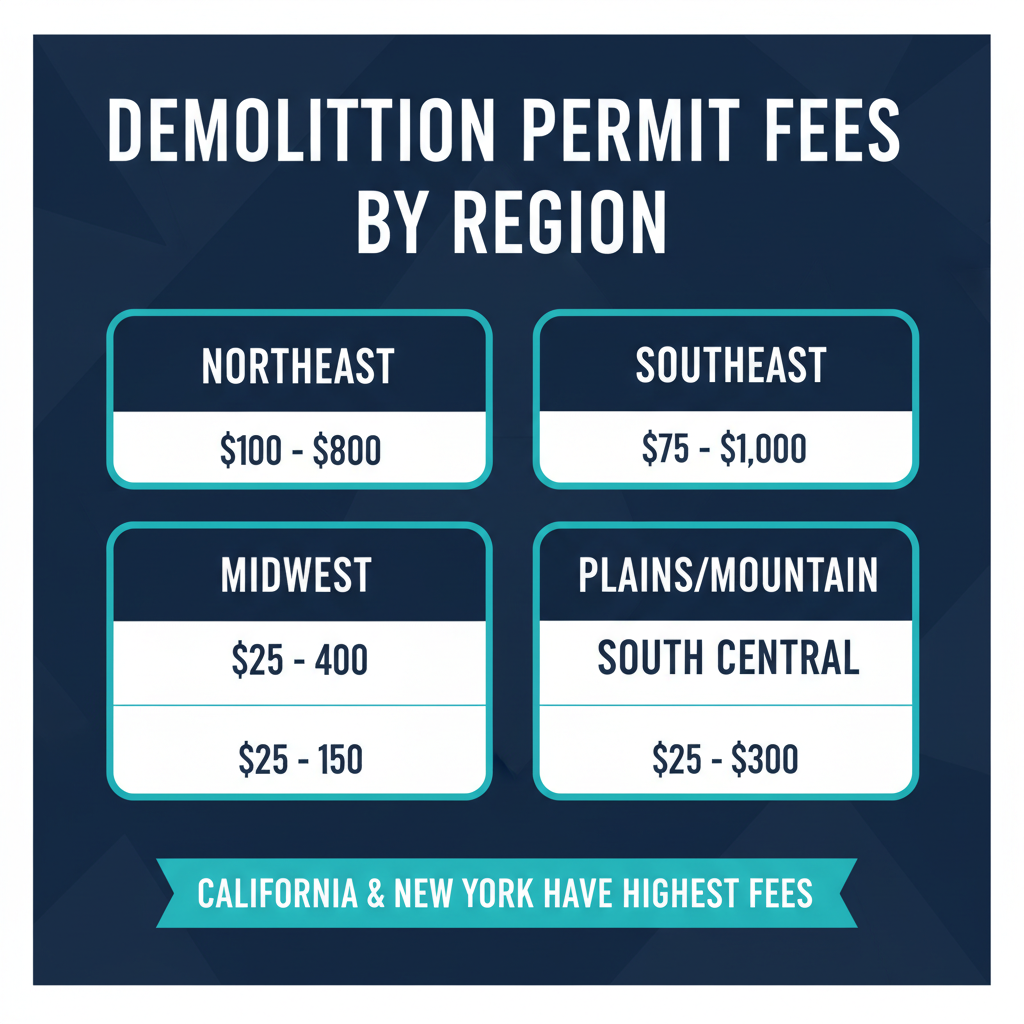
Permit fees are set at the municipal level, so they vary not just by state but by city and county within each state. That said, clear regional patterns emerge:
| Region | Residential Fee Range | Key Pattern |
|---|---|---|
| Northeast (NY, NJ, MA, CT) | $100–$800 | Highest fees; strictest historic preservation requirements |
| West Coast (CA, WA, OR) | $75–$1,000 | High fees + mandatory asbestos survey + deconstruction requirements in some cities |
| Southeast (FL, GA, NC, SC) | $50–$500 | Moderate fees; Florida requires asbestos survey statewide |
| Midwest (OH, IN, MI, IL) | $25–$400 | Moderate fees; Chicago is the outlier with higher costs |
| Plains / Mountain (MT, WY, SD, ND) | $25–$150 | Lowest fees; some rural counties exempt agricultural structures |
| South Central (TX, LA, MS, AR) | $25–$300 | Low to moderate; Houston has no zoning but still requires demo permits |
Use the permit fee lookup tool above to see estimated fees for your specific state, including processing timelines and state-specific notes about local requirements.
When Is a Demolition Permit Required?
The short answer: almost always. But the specific trigger points depend on your jurisdiction's building code. Here's the general framework:
Always Requires a Permit
Complete demolition of any residential structure (house, garage, barn, shed over a certain size). Complete demolition of any commercial or industrial structure. Demolition of any structure in a historic district. Removal of a swimming pool. Removal of underground storage tanks. Any demolition involving asbestos-containing materials.
Usually Requires a Permit
Removal of load-bearing walls during interior demolition or remodeling. Significant structural modifications. Removing an attached garage (because it affects the primary structure). Concrete foundation or slab removal in many jurisdictions.
Often Exempt from Permits
Small sheds under 120–200 square feet (threshold varies). Non-structural interior work like removing cabinets, flooring, or non-load-bearing walls. Tile removal and drywall removal as part of renovation. Removing fencing. Detached structures under the size threshold set by your municipality.
When in doubt, call your local building department before starting any demolition work. The call is free. The fine for unpermitted work is not.
How to Get a Demolition Permit: Step by Step
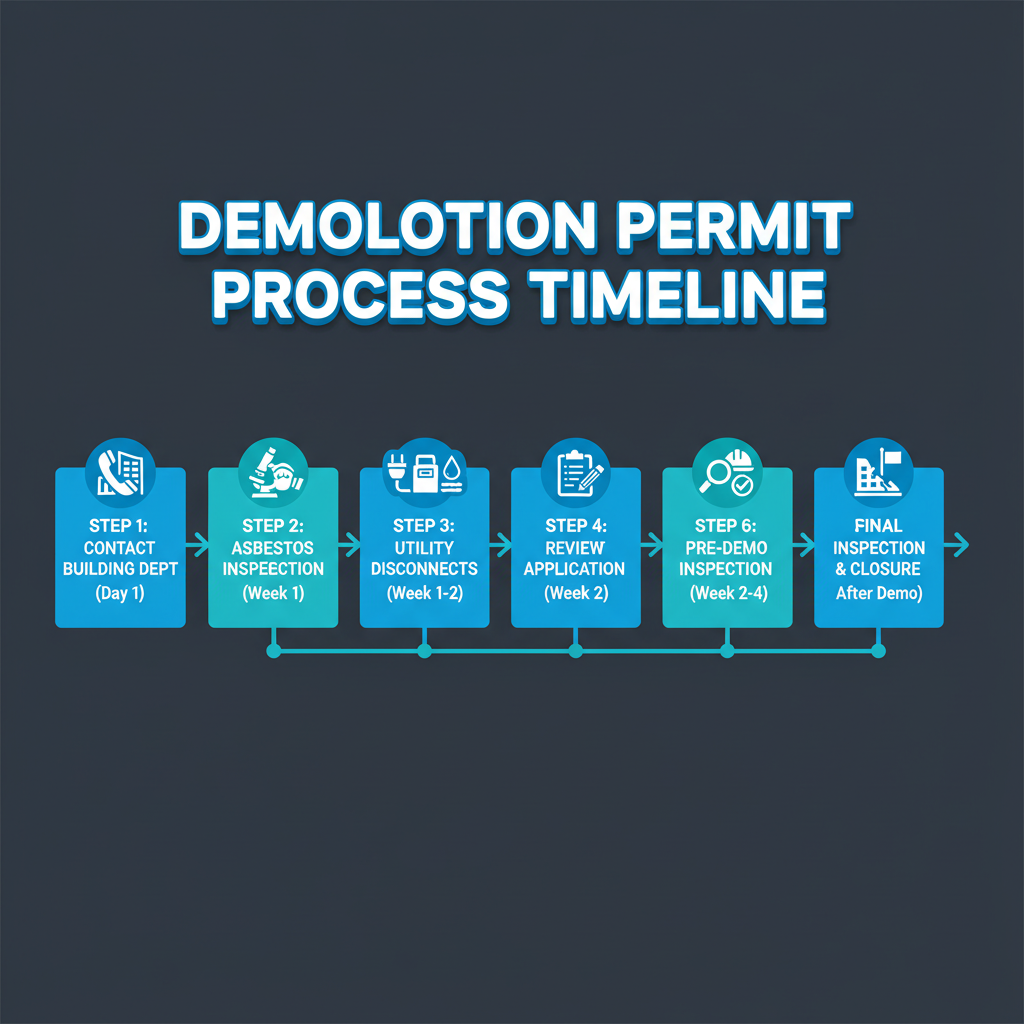
Step 1: Contact your local building department
Call or visit your city or county building department's website. Ask specifically about demolition permit requirements, the application form, what documentation you need to submit, the permit fee, and the expected processing timeline. Many municipalities have the application form available online.
Step 2: Schedule required inspections
Most jurisdictions require an asbestos inspection before issuing a demolition permit for any structure built before 1980. Some also require lead paint testing. Schedule these before submitting your application — the results are part of your permit application package. The inspection typically costs $200–$500 and takes 1–3 days for results.
Step 3: Arrange utility disconnects
Contact every utility provider serving the structure: electric, gas, water, sewer, cable, and telephone. Request disconnection and provide documentation of the disconnect to the building department. Most jurisdictions will not issue a demolition permit without proof that utilities have been disconnected. Allow 1–2 weeks for all disconnections to be completed.
Step 4: Submit the permit application
The application typically requires: property owner information, contractor information (if using a professional), a site plan showing the structure to be demolished, proof of asbestos inspection, proof of utility disconnection, and the permit fee payment. Some jurisdictions also require proof of liability insurance and a demolition plan describing the method and timeline.
Step 5: Wait for approval and plan review
Residential permits typically take 3–14 business days for review and issuance. Commercial permits may require a formal plan review, which can take 10–30 days. If your property is in a historic district, the review process can extend to 30–90 days while the historical commission or preservation board evaluates the application.
Step 6: Schedule pre-demolition inspection
Some jurisdictions require a pre-demolition site inspection by a building inspector before work begins. This confirms that the site matches the application, utilities are confirmed disconnected, and any required hazardous material abatement has been completed. The inspection is usually included in the permit fee.
Step 7: Post-demolition inspection and permit closure
After demolition is complete, schedule a final inspection. The inspector confirms the site has been properly cleared, graded, and secured. Once approved, the permit is closed. This step is important — an open permit can complicate future property sales or new construction permit applications.
Common Issues When Pulling Demolition Permits
Missing asbestos documentation. This is the number one reason demolition permit applications are delayed or denied. If the structure was built before 1980, most jurisdictions require a certified asbestos survey before they'll process your application. Don't submit without it — the application will be returned.
Utility accounts still active. Building departments check that gas, electric, and water have been disconnected before approving a demo permit. One missed utility can hold up the entire application. Start the disconnect process at least two weeks before you plan to submit.
Historic district complications. If the structure is in a designated historic district or is eligible for historic designation, the permit process adds an extra review layer. Some cities require the applicant to prove the structure cannot be economically rehabilitated before a demolition permit is granted. This can add months to the timeline and require documentation from an architect or structural engineer.
Neighbor notification requirements. Several municipalities require the applicant to notify adjacent property owners before demolition begins. This is sometimes a prerequisite for permit approval, sometimes just a requirement before work starts. Check whether your jurisdiction has a notification requirement — missing it can result in a stop-work order after demolition has already begun.
Contractor licensing issues. Many jurisdictions require the demolition contractor to hold a specific demolition license or general contractor license. If your contractor isn't properly licensed in the jurisdiction where the work is happening, the permit application may be denied. Verify your contractor's licensing status before submitting.
Failing to close the permit. After demolition is complete, many property owners forget to schedule the final inspection and formally close the permit. An open permit shows up on title searches and can complicate property sales, refinancing, and future construction permits. Always close the permit.
Commercial Demolition Permit Fees
Commercial demolition permits are significantly more expensive and complex than residential permits. The fee structure often includes multiple components:
| Component | Typical Cost | Notes |
|---|---|---|
| Base permit fee | $200–$2,000 | Often based on building square footage or project valuation |
| Plan review fee | $100–$1,000 | Required for most commercial demo; reviews structural safety plan |
| Environmental review | $200–$1,000 | Phase I or Phase II ESA may be required |
| Performance bond | $1,000–$25,000 | Guarantees site will be properly cleared and graded |
| Sidewalk/ROW permit | $50–$500 | Required if demolition affects public right-of-way |
| OSHA compliance docs | Contractor cost | Engineering survey required for structures over 3 stories |
The commercial plan review process involves the building department reviewing a detailed demolition plan that includes the proposed method, equipment, timeline, debris management plan, dust and noise mitigation, traffic control (if applicable), and a structural engineering assessment. This review can take 10–30 business days and sometimes requires revisions before approval is granted.
Demolition Permit Requirements by Project Type
Different types of demolition projects have different permit requirements. Here's how the process varies across the most common project types:
| Project Type | Permit Usually Required? | Typical Fee | Special Requirements |
|---|---|---|---|
| House Demolition | Yes — always | $100–$800 | Asbestos survey, utility disconnects, site plan |
| Barn Demolition | Yes — most areas | $50–$500 | Historic review in some states (PA, VT, NY) |
| Garage Demolition | Yes | $50–$300 | Attached garages require structural review |
| Pool Demolition | Yes | $75–$400 | Some cities require backfill inspection |
| Concrete Removal | Varies | $25–$200 | Foundation removal usually requires permit; flatwork sometimes exempt |
| Bathroom Demo | If structural | $50–$200 | Only if removing load-bearing walls or relocating plumbing |
| Interior Demo | If structural | $50–$300 | Gut renovations with structural changes require permit |
| Commercial Building | Yes — always | $500–$5,000+ | Plan review, performance bond, OSHA engineering survey |
How to Save on Demolition Permit Costs
Check for fee waivers. Some municipalities waive or reduce permit fees for condemned structures, blight removal, or owner-occupied properties. Land bank programs in cities like Cleveland, Detroit, and Philadelphia often cover the full permit cost for qualifying properties.
Bundle permits. If you're demolishing and rebuilding, some jurisdictions offer a combined demolition-construction permit at a reduced total fee compared to pulling them separately.
Avoid rush fees. Expedited permit processing typically costs 50–100% more than standard processing. If your timeline allows, use the standard review timeline and save.
Get the asbestos survey early. The most common permit delay is waiting for asbestos survey results. Schedule the survey 2–3 weeks before you plan to submit the permit application. Having results ready when you apply avoids back-and-forth with the building department.
Have your contractor handle it. Most professional demolition contractors include permit handling in their bid. They know the local process, have existing relationships with building departments, and can often get permits processed faster than a homeowner navigating the system for the first time. Confirm the permit fee is included in their bid rather than an additional charge.
Violations: What Happens Without a Demolition Permit
Demolishing without a permit is one of the riskiest shortcuts in construction. The consequences can extend far beyond a simple fine:
Fines: Unpermitted demolition fines range from $500 to $10,000+ depending on jurisdiction and severity. Repeat violations carry higher penalties. Some cities double the standard permit fee as a penalty for after-the-fact permits.
Stop-work orders: If a building inspector discovers unpermitted demolition in progress, they can issue an immediate stop-work order. All work must cease until the situation is resolved — which can take weeks.
Property sale complications: Open or missing permits show up on title searches. Buyers and lenders may require resolution before closing, which can delay or kill a sale. After-the-fact permits are possible in some jurisdictions but come with higher fees and additional inspections.
New construction permit denial: If you demolished a structure without a permit and then apply for a building permit for new construction on the same site, the building department may deny your application until the unpermitted demolition is resolved.
Environmental liability: Demolishing a structure containing asbestos without proper abatement and permits can result in EPA enforcement action, which carries fines of $25,000–$75,000 per day of violation.
FAQ
Do I need a permit to demolish a house?
In almost every jurisdiction in the United States, yes. Residential demolition permits are required in virtually all cities and most counties. Even rural areas with relaxed building codes typically require at least a basic demolition permit for full structure teardowns. Fees range from $25 to $1,000 depending on your state and municipality.
How much does a demolition permit cost?
Residential demolition permit fees range from $25–$1,000 depending on location. The national average is $100–$400. Commercial demolition permits cost $200–$5,000+. California and New York have the highest fees. Rural southern and midwestern states typically have the lowest. Use the lookup tool above to check your state.
How long does it take to get a demolition permit?
Residential demolition permits typically take 3–14 business days for approval. Commercial permits can take 10–30 days or more due to plan review requirements. Expedited processing is available in many jurisdictions for an additional fee. Historic district reviews can add 30–90 days to the timeline.
Do you need a permit for demolition in Florida?
Yes. Florida requires demolition permits in all municipalities. Fees range from $100–$500 for residential projects. An asbestos survey is mandatory before permit issuance, and some Florida counties also require a rodent inspection for structures being demolished.
What is considered demolition work?
Demolition work includes the partial or complete removal of a structure. This covers tearing down houses, barns, garages, sheds, pools, interior gut renovations, and commercial buildings. Even removing a single load-bearing wall may require a demolition permit in some jurisdictions. Non-structural work like removing cabinets, flooring, or cosmetic finishes typically does not.
Are demolition permits necessary for interior work?
It depends on the scope. Removing non-structural elements like cabinets, flooring, and fixtures typically does not require a separate demolition permit. However, removing load-bearing walls, relocating plumbing or electrical, or making significant structural changes usually does require a permit. When in doubt, check with your local building department — the inquiry is free.
What happens if you demolish without a permit?
Unpermitted demolition can result in fines ranging from $500 to $10,000+, stop-work orders, difficulty selling the property, inability to get building permits for new construction on the site, and potential EPA enforcement action if hazardous materials were not properly handled. After-the-fact permits are sometimes available but come with penalty fees.
Related Calculators
Use these calculators to estimate the total demolition cost alongside your permit budget:
- House Demolition Cost Calculator — Full residential teardown estimates ($6,000–$25,000)
- Barn Demolition Cost Calculator — Barn teardown with salvage value analysis ($3,000–$15,000)
- Garage Demolition Cost Calculator — Attached and detached garage removal
- Pool Demolition Cost Calculator — Inground and above ground pool removal
- Concrete Demolition Cost Calculator — Foundation and slab removal
Data Sources & Methodology
Permit fee ranges are compiled from publicly available municipal fee schedules across 200+ jurisdictions, supplemented by direct inquiries to county building departments. Processing timelines reflect reported averages from permit applicants and building department staff. Fees are updated annually. Actual costs vary by municipality — always confirm with your local building department before budgeting.