What Is a House Demolition Cost Calculator?
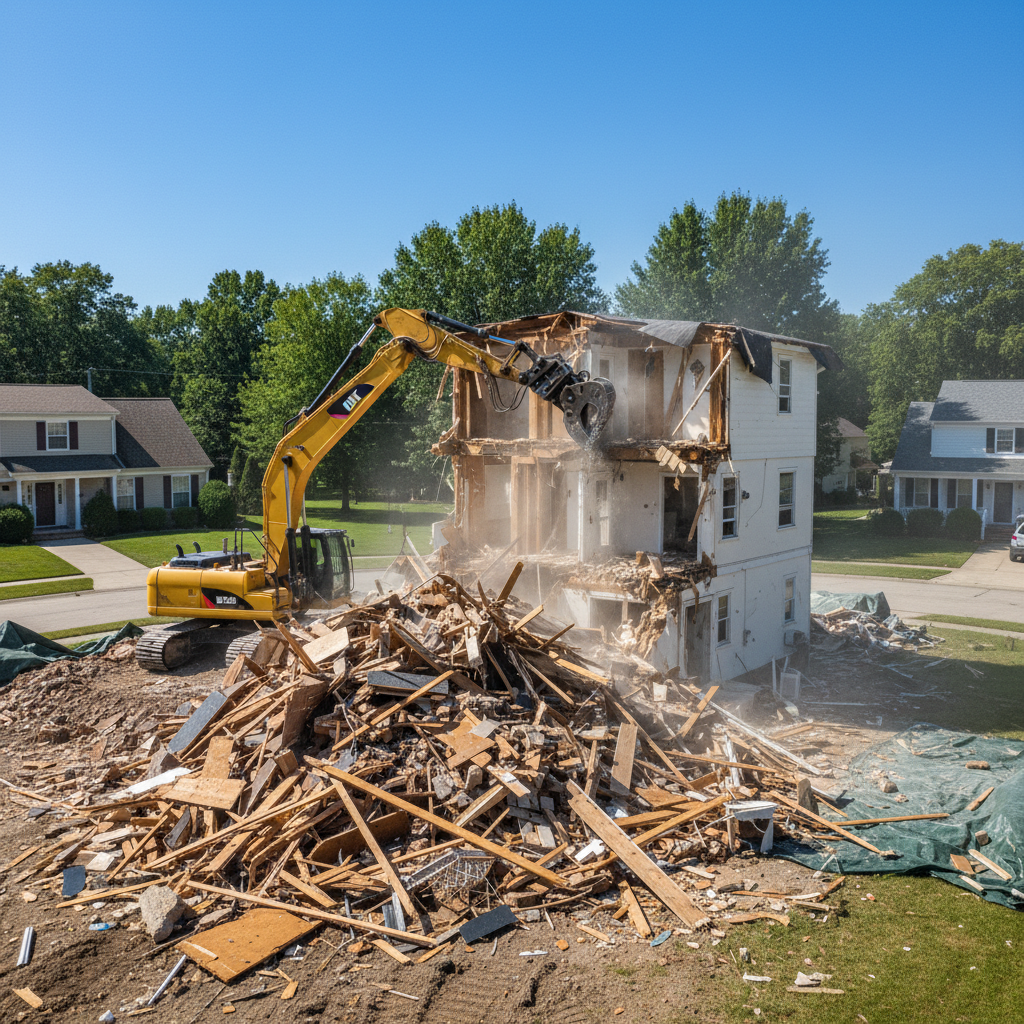
A house demolition cost calculator is an automated tool that estimates what it costs to tear down a residential structure. It uses state-specific labor data, material complexity factors, and regional disposal rates to generate realistic project ranges — whether you're pricing a straightforward wood-frame teardown in the South's most affordable labor market or navigating California's regulation-heavy demolition process where environmental compliance alone can add thousands before any equipment arrives on site.
This calculator also helps you estimate the cost to tear down a house, residential structure removal pricing, home demolition budgeting, teardown cost analysis by material type, and bulldoze-and-rebuild feasibility — all using state-specific labor and disposal data.
Understanding demolition costs before contacting contractors helps homeowners, investors, and developers evaluate bids against real market data. On a demolition project, one uninformed bid can cost you $5,000–$10,000.
How Much Does It Cost to Demolish a House in 2025–2026?
House demolition costs span an enormous range across the United States — wider than most homeowners expect. The gap between the cheapest and most expensive markets is roughly 8×, driven almost entirely by labor rates, disposal infrastructure, and regulatory environment rather than the difficulty of the work itself.
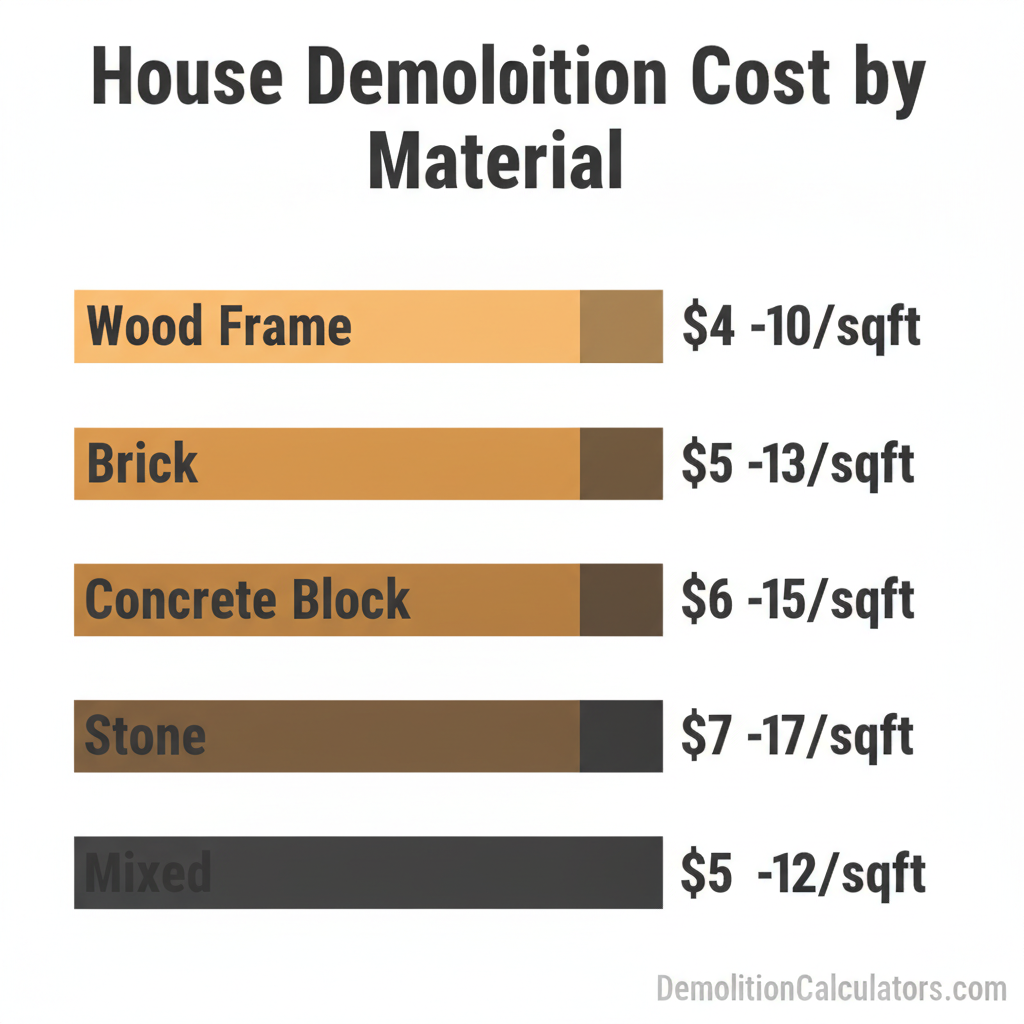
| Construction Type | Cost Per Sq Ft | 2,000 Sq Ft Home | Market Profile |
|---|---|---|---|
| Wood Frame | $4 – $10 | $8,000 – $20,000 | Fastest, most affordable |
| Brick Veneer | $5 – $13 | $10,400 – $26,000 | Moderate complexity |
| Concrete Block | $6 – $15 | $12,000 – $30,000 | Heavy equipment required |
| Stone/Masonry | $7 – $17 | $14,000 – $34,000 | Most labor-intensive |
| Mixed Materials | $5 – $12 | $10,000 – $24,000 | Variable by composition |
📊 Key Insights from the Data:
The lowest-cost demolition markets cluster in the Deep South — Mississippi, Arkansas, and West Virginia — where labor rates sit around $32–$34/hour and landfill tipping fees remain under $45/cubic yard. A standard wood-frame teardown in these markets can come in under $8,000 total.
At the opposite end, Hawaii's isolated market produces the nation's highest demolition costs. Limited landfill capacity drives disposal fees to $90/cubic yard, and the contractor pool is small enough that pricing reflects genuine scarcity rather than just wage inflation. A straightforward 2,000 sq ft teardown in Honolulu can exceed $40,000.
Texas demonstrates how much geography matters within a single state. A rural teardown in West Texas costs $4/sq ft — but the same structure 300 miles east in Austin's suburbs runs $10–$14/sq ft. Same state regulations, dramatically different labor markets.
California adds a layer that doesn't exist in most states: environmental compliance. AQMD air quality permits, mandatory C&D waste diversion requiring contractors to sort debris rather than bulk-haul it, and CEQA environmental review create both direct costs and timeline delays. Contractors will tell you the regulation adds 15–25% to every residential project.
The national average for a standard 2,000 sq ft wood-frame home sits around $12,000–$15,000 — but this number masks so much regional variation that it's almost misleading without state context.
Asbestos remains the wildcard. Professional abatement runs $2,000–$10,000 depending on contamination extent, and it hits with equal force regardless of your local market — the same federal NESHAP regulations apply everywhere.
🔍 Quick Comparison:
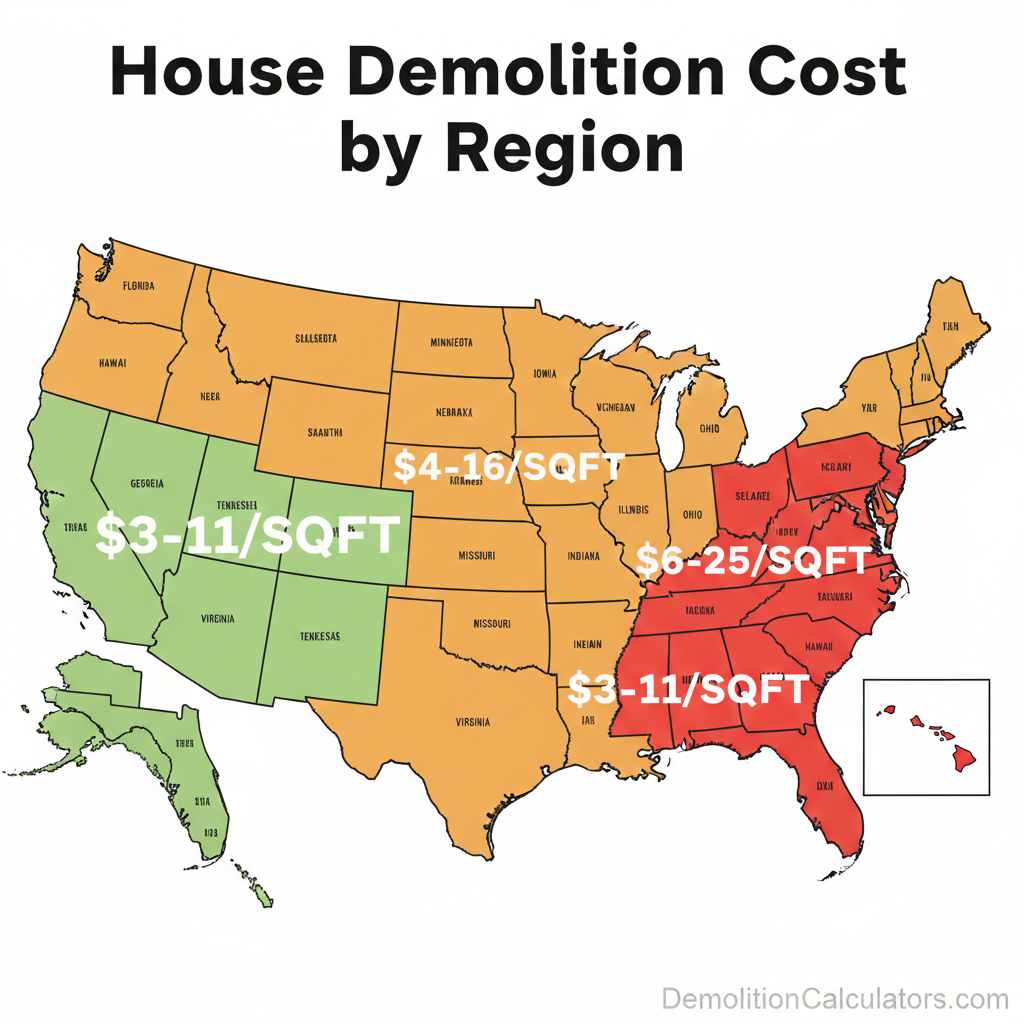
- Low-cost markets (Mississippi, Arkansas, West Virginia) deliver demolition at $3–$11/sq ft on lower wages and disposal rates
- Mid-range markets (Texas, Ohio, Florida, Pennsylvania) track national averages at $4–$16/sq ft
- Premium markets (California, New York, Hawaii, Massachusetts) run $6–$25/sq ft driven by labor, regulation, and disposal
- Hazardous material abatement applies universally — pre-1980 homes face $2,000–$10,000+ regardless of state
👉 Concrete Demolition Cost Calculator — for standalone slab, driveway, or foundation removal estimates
How Our Free House Demolition Cost Calculator Works
Our calculator uses a multi-factor formula that mirrors how professional estimators actually price demolition work — simplified for instant results. Here's what happens behind the scenes, calibrated with BLS wage data and state disposal rate databases:
1. Location & Labor Rate Adjustment
Location drives more cost variation than any other single factor. Our system applies state-adjusted labor multipliers derived from BLS occupational wage data. The spread is significant: demolition workers in low-cost Southern states earn roughly $32/hour, while the same trade in premium island markets commands $58/hour — an 81% gap that flows directly into every hour of on-site work. In practical terms, the same teardown that costs under $10,000 in an affordable market can run $40,000+ where labor and disposal are at their highest.
2. Construction Material Classification
Material determines both equipment requirements and the pace of work. Wood frame is fastest — a competent crew with a standard excavator can drop a single-story wood-frame house in a day, sometimes less. Brick and concrete change the equation. Hydraulic breakers replace bucket attachments, work slows by 30–50%, and the debris is heavier — which means more truck loads, more disposal weight, and higher landfill fees per cubic yard.
3. Foundation Type & Removal
Foundation removal adds a fixed cost layer on top of the per-square-foot calculation. Pier foundations run about $800. Slab foundations cost approximately $1,500 to break and remove. Crawl spaces are trickier at around $2,500 because of access constraints. Full basements are the expensive scenario at $3,000–$5,000, requiring excavation and multiple rounds of compacted backfill to prevent future settling. The math: Base demolition ($4–$17/sq ft × home size) + Foundation removal ($800–$5,000) + Hazardous abatement (if applicable) + Permits + Disposal = Total estimated cost.
4. Hazardous Material Assessment
This is the cost that catches people off guard. Homes built before 1980 may contain asbestos in insulation, floor tiles, siding, and pipe wrapping. Testing alone costs $200–$800 — and if contamination is found, professional abatement runs $2,000–$10,000+ before the demolition crew can touch the structure. Federal regulations make no distinction between cheap markets and expensive ones. The abatement cost is the abatement cost.
5. Disposal & Debris Volume
Disposal is often the second-largest line item after labor, and it's the one homeowners most frequently underestimate. A typical 2,000 sq ft single-story home generates 150–200 cubic yards of debris. At landfill rates ranging from $38/cubic yard in affordable markets to $90/cubic yard in capacity-constrained areas, disposal alone can represent $5,700–$18,000 of the total project cost. That's 30–40% of the budget on some projects.
What Affects House Demolition Cost the Most? 12 Critical Factors
House demolition pricing involves dozens of variables, but these twelve factors consistently determine where your project lands within the cost range:
1. Home Size (Square Footage)
The primary cost multiplier. Every additional 500 sq ft adds roughly $2,000–$8,500 to the total depending on your local labor and disposal rates. The relationship is roughly linear — a 3,000 sq ft home costs approximately 3× what a 1,000 sq ft structure does. No surprises here.
2. Construction Material
Wood frame at $4–$10/sq ft is the fastest and cheapest to demolish. Concrete block and stone at $6–$17/sq ft require specialized equipment and generate significantly heavier debris.
3. Number of Stories
Multi-story work costs 20–40% more than single-story for a comparable footprint. The reasons are practical: fall protection, temporary shoring, controlled collapse sequencing, and the simple reality that working at height is slower. Three-story structures push the premium to 50–70%.
4. Foundation Type
The range runs from $800 (pier) to $5,000 (full basement). What most homeowners don't realize is that basement removal also extends the project timeline by 1–2 days because of the backfill and compaction cycles required.
5. Hazardous Materials
Asbestos abatement at $2,000–$10,000 and lead paint at $1,500–$5,000 exist outside the normal demolition budget. They require separate licensed specialists, separate disposal protocols, and separate timelines.
6. State Labor Rates
BLS wage data shows an 81% spread between the cheapest and most expensive state labor markets for demolition trades. This single factor drives more variation in final project cost than any other variable except home size.
7. Site Accessibility
This one is harder to estimate remotely. Restricted lot access, slopes, mature trees near the structure, or limited staging area for equipment can push costs up 25–50%. Homes where an excavator can't maneuver freely sometimes require partial manual demolition — significantly slower and more expensive.
8. Demolition Method
Mechanical demolition is the cost baseline. Deconstruction — carefully taking a house apart by hand to salvage materials — costs 50–80% more in labor. The trade-off is material resale value and potential tax deductions.
9. Disposal & Landfill Fees
Disposal rates vary nearly as much as labor rates. Low-cost markets charge $38–$45/cubic yard. Premium markets hit $80–$90/cubic yard. For a home generating 150+ cubic yards of debris, that's the difference between $5,700 and $18,000 on disposal alone.
10. Permit Requirements
Permits range from $50 in small towns to $500+ in major cities. But the real cost in regulation-heavy states isn't the permit fee — it's the timeline. Environmental review in California can add 2–4 weeks before any demolition work begins.
11. Utility Disconnection
Gas, electric, water, sewer, and telecom must be professionally disconnected. Budget $200–$500 per service in most markets.
12. Attached Structures
An attached two-car garage adds $3,000–$5,000. A large deck adds $1,000–$5,000. These costs are additive — a home with a garage, deck, and screened porch could see $4,500–$12,000 on top of the base estimate.
👉 Garage teardown costs — for standalone garage demolition estimates
👉 Deck removal pricing — for deck demolition and disposal estimates
House Demolition Cost by State (2025–2026)
Based on our latest BLS wage data and state disposal rate analysis, here's what house demolition costs look like across key markets for a standard 2,000 sq ft single-story wood-frame home:
House Demolition Cost in Mississippi – $3–$10/sq ft | Most Affordable
Market Profile: Lowest nationally. Mississippi's demolition costs reflect the nation's most affordable labor market — $32/hour average for demolition trades, the lowest BLS figure in the country. Landfill tipping fees hover around $38/cubic yard, and permit processes are straightforward with minimal regulatory overhead. A standard wood-frame teardown runs $6,000–$20,000, with the lower end representing rural structures with good site access. The 45% discount to national average pricing makes Mississippi the benchmark low-cost market — and the state that reveals just how much of demolition cost is really labor cost.
House Demolition Cost in Texas – $4–$14/sq ft | Widest Variance
Market Profile: Geographic diversity. Texas displays the widest spread between low and high demolition costs of any state, and the reason is simple geography. West Texas — open, flat, sparsely populated — produces teardowns at $4/sq ft with local crews who handle everything in-house. Drive 300 miles east to Austin, Dallas, or Houston suburbs, and you're in a different labor market entirely: $10–$14/sq ft reflecting urban demand, higher wages, and disposal logistics that rural contractors never deal with. State-level averages for Texas are almost meaningless. The city matters more than the state.
House Demolition Cost in Florida – $4–$15/sq ft | Hurricane Variable
Market Profile: Moderate with demand surges. Under normal conditions, Florida tracks mid-range nationally at $4–$15/sq ft with $38/hour labor and $50/cubic yard disposal. What makes Florida unique is the hurricane factor. Major storm seasons create demolition demand spikes that temporarily inflate contractor rates 30–50% as damaged properties overwhelm local capacity. The I-4 corridor between Tampa and Orlando commands the highest steady-state rates. Timing matters in Florida more than almost any other market.
House Demolition Cost in California – $6–$22/sq ft | Regulation Premium
Market Profile: Compliance-driven cost structure. California isn't just expensive because labor costs more — though it does, at $55/hour. What really separates California is the regulatory stack. AQMD air quality permits require dust mitigation plans. CalRecycle mandates that contractors divert a percentage of C&D waste from landfills, which means sorting debris on-site rather than bulk-loading dumpsters. CEQA environmental review can trigger on demolitions near sensitive habitats or in historic areas, adding weeks of timeline and thousands in consultant fees. A Bay Area demolition that would cost $8,000 in a comparable Southern market routinely runs $25,000–$44,000. The structure being demolished is the same; the compliance environment is not.
House Demolition Cost in New York – $7–$22/sq ft | Metro Premium
Market Profile: Urban complexity. New York's cost structure splits cleanly between upstate and downstate. Upstate demolitions — Buffalo, Syracuse, Rochester — run $7–$14/sq ft with labor and logistics comparable to other Northeastern metros. New York City is a different universe. Union labor requirements, confined site access that prohibits standard-size excavators on many residential lots, specialized permitting through DOB, and limited debris staging create a cost environment where $20–$22/sq ft is routine. The five boroughs represent perhaps the most expensive residential demolition market in the continental United States.
House Demolition Cost in Hawaii – $8–$25/sq ft | Isolation Premium
Market Profile: Highest nationally. Hawaii's demolition costs aren't driven by regulation or urban complexity — they're driven by isolation. Equipment costs more because it ships by barge. The contractor pool is small, creating genuine scarcity pricing. And critically, landfill capacity is physically constrained by island geography, pushing disposal to $90/cubic yard — more than double the mainland average. A standard 2,000 sq ft teardown in Honolulu costs $16,000–$50,000. Even experienced mainland contractors are sometimes surprised by the numbers.
The math is worth seeing clearly: the same 2,000 sq ft wood-frame house — identical construction, identical complexity — costs $6,000 in an affordable Southern market and $50,000 in Hawaii. That's an 8× multiplier, and it has nothing to do with the house. It's entirely location: labor market, disposal infrastructure, and regulatory environment.
Why this matters for investors and developers: If you're evaluating teardown-rebuild economics, your state's demolition cost profile is a fundamental input. A low-cost market teardown-rebuild pencils out at $130,000–$200,000 total. The same project scope in premium markets requires $260,000–$500,000 — with demolition consuming 10–15% of that budget versus 5% in affordable states.
Cost to Bulldoze a House vs. Deconstruction
The two primary approaches to residential demolition produce very different cost profiles — and the right choice depends on the house itself as much as the budget.
| Factor | Mechanical Demolition | Deconstruction |
|---|---|---|
| Cost per sq ft | $4 – $17 (baseline) | $7 – $30 (50–80% premium) |
| Timeline | 1–3 days | 1–3 weeks |
| Material salvage | Minimal | Significant ($500–$5,000+ resale) |
| Tax benefits | None | Potential deduction for donated materials |
| Best for | Post-1970 standard construction | Pre-1950 homes with valuable materials |
| Environmental impact | Higher landfill volume | Lower through material reuse |
The math on deconstruction only works in specific situations. For a standard 1990s subdivision house, mechanical demolition wins on every metric — it's faster, cheaper, and the salvage value of modern construction materials is negligible. But pre-1950 homes change the calculation. Old-growth lumber, original hardwood flooring, period fixtures, and architectural details can generate $3,000–$8,000 in resale value. Combined with potential tax deductions, deconstruction can approach cost-parity with mechanical demolition on the right house.
Why this matters: Contractors will almost always default to mechanical demolition because it's faster for them. If your house is pre-1950 with original materials intact, it's worth getting a deconstruction bid alongside mechanical quotes — the economics might surprise you.
How Accurate Is an Online House Demolition Cost Calculator?
Typical Accuracy Range: Our calculator provides 80–90% accuracy for standard residential demolitions in active contractor markets. That's honest — it's a planning tool, not a quote.
When accuracy is highest: Standard wood-frame homes under 2,500 sq ft with straightforward site access, in states with stable contractor markets and published disposal rates. Mid-range markets tend to produce the most reliable estimates.
When accuracy may vary: Properties with unknown hazardous materials, unusual construction, significant access constraints, or in markets with thin contractor pools.
| Factor | Online Calculator | Licensed Contractor Quote |
|---|---|---|
| Speed | Instant | 3–7 days (includes site visit) |
| Cost | Free | Free (most contractors quote at no charge) |
| Site inspection | No | Yes — catches hidden issues |
| Legal basis | Estimate only | Binding contract basis |
| Accuracy | 80–90% for standard projects | 95%+ with site inspection |
| Best for | Initial budgeting, bid evaluation | Final project commitment |
Important Note: Contractors may identify issues no calculator can detect — underground storage tanks, structural problems that change the demolition approach, or utility complications. The calculator tells you what to expect. The contractor tells you what it will actually cost.
When Should You Get Professional Demolition Quotes?
💰 Projects Above $10,000 – Most residential demolitions clear this threshold. At these dollar amounts, the difference between the lowest and highest contractor bid can easily be $5,000–$8,000 for identical scope. Multiple quotes aren't optional.
🏦 Teardown-Rebuild Planning – Demolition and new construction need to be coordinated. A contractor who knows you're building after can adjust scope — keeping the foundation if it's sound, grading to construction specs, capping utilities for reconnection.
⚖️ Unknown Hazardous Materials – If your home was built before 1980, professional assessment is essential. The $200–$800 testing cost is trivial compared to abatement — and both are trivial compared to the legal liability of improper handling.
📝 Complex Permitting – Regulation-heavy jurisdictions require specialized knowledge. Local contractors navigate these systems weekly.
💼 Difficult Sites – Homes with shared walls, steep lots, mature trees within the demolition footprint, or limited equipment access need professional eyes.
🌍 Insurance or Estate Situations – Insurance settlements, estate liquidations, and code enforcement demolitions require documentation that online estimates cannot provide.
Frequently Asked Questions About House Demolition Cost
How much does it cost to demolish a house?
House demolition costs range from $6,000 to $25,000 for a standard residential structure, with the national average around $12,000–$15,000 for a 2,000 sq ft wood-frame home. Per square foot, expect $4–$17 depending on material and location. Low-cost Southern markets come in under $10,000 for many projects, while premium states routinely exceed $25,000.
How much does it cost to bulldoze a house?
Bulldozing — mechanical demolition using an excavator — is the most common approach at $4–$17/sq ft. A 2,000 sq ft home costs $8,000–$34,000 to bulldoze. Texas shows the widest in-state range: $4/sq ft in rural areas versus $14/sq ft near major metros.
What is the cheapest way to demolish a house?
Schedule during off-peak months (late fall and winter) for 10–20% savings. Salvage valuable materials before the crew arrives. Handle interior prep yourself. Get at minimum three competitive quotes. And choose mechanical demolition unless the house is pre-1950 with genuinely valuable materials worth deconstructing.
How long does it take to demolish a house?
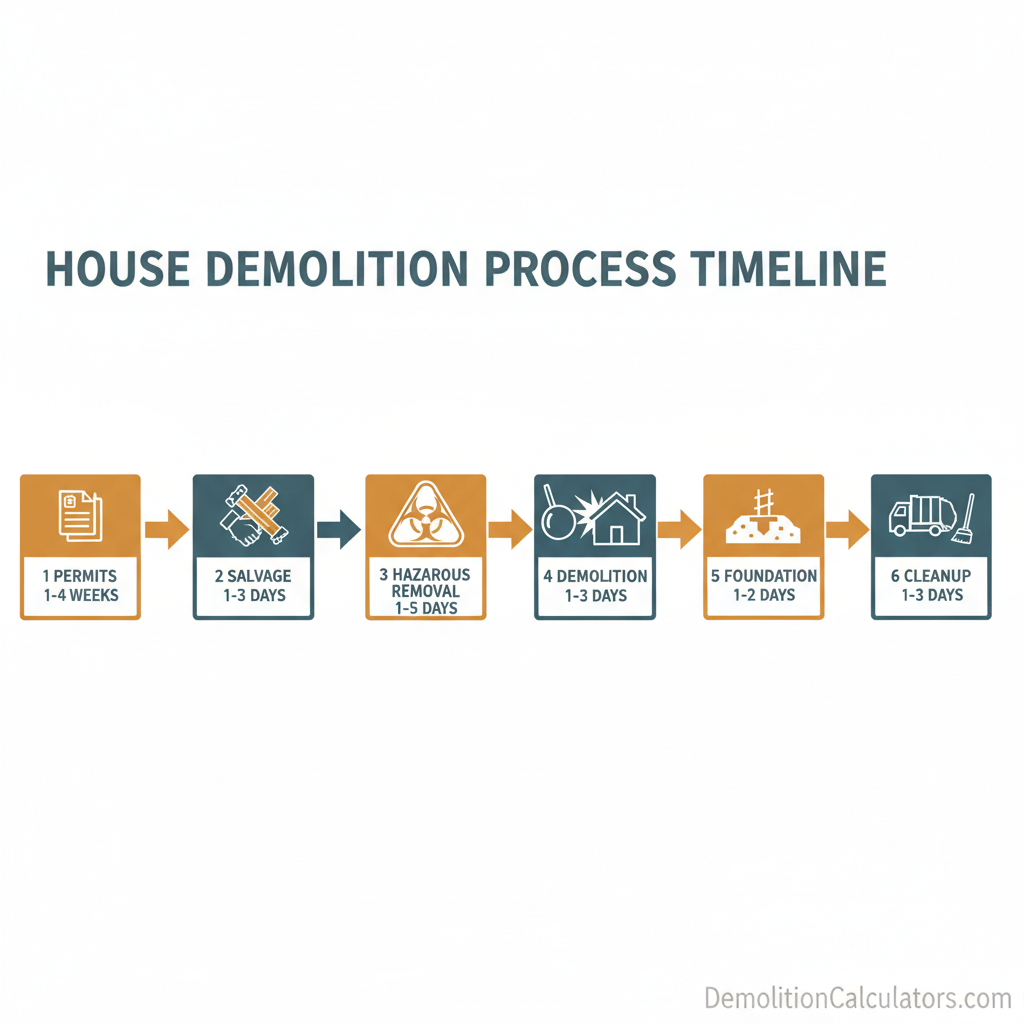
The demolition itself takes 1–3 days for wood frame, 3–5 days for concrete or masonry. Total project time — including permits, utility disconnection, any hazardous abatement, and site cleanup — runs 1–3 weeks. Heavily regulated markets can extend to 4–6 weeks.
Do I need a permit to demolish a house?
Yes. Virtually every U.S. municipality requires a demolition permit. Fees range from $50 to $500+. Your contractor typically handles permitting as part of their scope — it's one of the things you're paying for when you hire a professional.
Is it cheaper to renovate or demolish and rebuild?
When renovation costs exceed 50–60% of new construction costs, rebuilding usually makes more economic sense. Total teardown-rebuild projects run $130–$250/sq ft. Demolition alone represents 5–10% of that total.
Does asbestos increase demolition cost?
Significantly. Testing is $200–$800. Abatement is $2,000–$10,000+ depending on extent. Federal NESHAP regulations require identical protocols in every state — there's no discount for being in a cheaper labor market.
What factors influence house demolition cost the most?
The three biggest factors are home size, state labor rates, and construction material. Together they determine roughly 70% of the total cost. Hazardous materials, foundation type, and disposal fees account for most of the remainder.
Why is demolition so expensive in California and New York?
Both combine premium labor rates ($55/hour) with expensive disposal ($80–$85/cubic yard). The real differentiator is regulatory cost. California's environmental compliance stack adds layers that don't exist in most states. New York City adds union labor and extreme space constraints.
Can I demolish a house myself?
Small-scale interior demo is reasonable DIY work. Full structural demolition is not. Most jurisdictions require licensed contractors. The safety risks create liability exposure that far exceeds the $2,000–$5,000 you might save on labor.
Related Demolition Calculators You Might Need
Maximize your project planning with these complementary estimators:
- Garage Demolition Cost Calculator – Attached and detached garage teardown estimates
- Concrete Demolition Cost Calculator – Driveway, patio, slab, and foundation removal at $2–$10/sq ft
- Pool Demolition Cost Calculator – Inground removal ($4,000–$16,000) and above-ground ($300–$2,500)
- Bathroom Demolition Cost Calculator – Gut renovation demo from $500 to $5,000
- Wall Demolition Cost Calculator – Load-bearing and non-load-bearing wall removal
- Interior Demolition Cost Calculator – Selective interior demo at $2–$7/sq ft
- Deck Demolition Cost Calculator – Deck removal at $5–$15/sq ft
- Demolition Permit Cost Calculator – State-by-state permit fees
Each tool uses BLS wage data and state disposal rates for localized estimates.
Data Sources & Methodology
Our house demolition cost estimates draw from publicly verifiable, regularly updated data sources:
- 🏛️ Bureau of Labor Statistics (BLS) – Occupational Employment and Wage Statistics for demolition trades by state and metro area
- 📊 State Environmental Agencies – Published landfill tipping fees and C&D debris disposal rates
- 🏢 Municipal Building Departments – Demolition permit fee schedules across all 50 states
- ⚖️ EPA NESHAP Regulations – Asbestos emission standards and abatement cost frameworks
- 📈 Regional Cost Indices – RSMeans construction cost data for geographic adjustments
- 🌐 Contractor Survey Data – Aggregated pricing from licensed demolition contractors, quarterly updated
Update Frequency: Our data refreshes quarterly with new BLS wage releases and state disposal rate publications. State-specific figures represent 2025–2026 market conditions.