How much does deck removal cost?
Most homeowners pay $1,000–$2,500 for professional deck demolition and removal. Small ground-level decks start at $300. Large elevated decks with concrete footings can exceed $5,000. Costs vary by deck size, height, material, and local labor rates.
What Is a Deck Removal Cost Calculator?
A deck removal cost calculator estimates what it costs to tear down and haul away an old deck or patio structure. It factors in the deck size, material (wood decking, composite, or concrete), height above ground, and your state's labor and disposal rates to generate a realistic cost range.
This calculator also helps you estimate deck demolition and removal pricing, wood decking teardown costs, concrete patio removal budgeting, and DIY vs professional deck demolition comparison — all using state-specific labor and disposal data.
Deck removal is one of those projects where the cost range is wide enough to be confusing. Based on our contractor pricing surveys, bids on the same deck removal project routinely vary by 40–60%. A homeowner who walks in knowing the fair price for their deck size and complexity is in a much stronger negotiating position.
How Much Does Deck Removal Cost?
The average deck removal cost ranges from $500 to $5,000 for most residential projects. Most homeowners removing a standard wood deck pay between $1,000 and $2,500 including demolition, debris hauling, and basic site cleanup.
| Deck Type | Size | Average Cost | Includes |
|---|---|---|---|
| Small ground-level wood | Under 150 sq ft | $300–$1,000 | Demo + haul away |
| Medium ground-level wood | 150–300 sq ft | $1,000–$2,000 | Demo + haul away |
| Large ground-level wood | 300–600 sq ft | $1,500–$3,500 | Demo + haul away |
| Elevated wood deck | 150–400 sq ft | $1,500–$4,000 | Demo + stairs + railing + haul |
| Multi-level deck | 300–600+ sq ft | $2,500–$5,000+ | Complex teardown + haul |
| Composite deck | Any size | $800–$3,000 | Heavier material, similar labor |
| Concrete patio | 100–400 sq ft | $1,000–$3,500 | Breaking + removal + haul |
| Brick paver patio | 100–400 sq ft | $500–$2,000 | Lift + haul (pavers may be salvageable) |
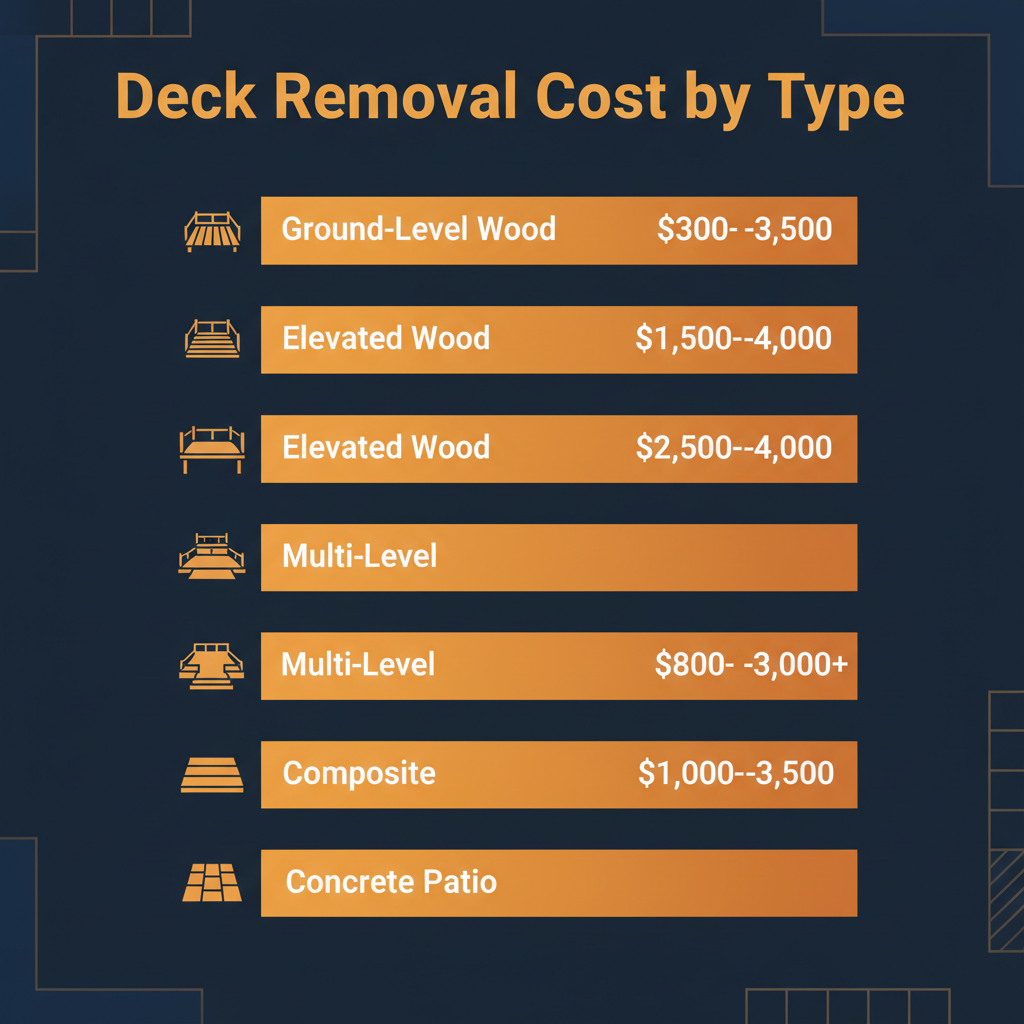
These prices include demolition labor, debris removal, and basic site cleanup. They do not include concrete footing removal, landscaping or grading, permit fees, or hazardous material handling for decks built with older pressure-treated lumber.
Deck Removal Cost Per Square Foot
Deck removal cost per square foot ranges from $3 to $10 for most projects. Ground-level wood decks fall at the lower end ($3–$5/sq ft). Elevated decks and concrete patios run higher ($5–$10/sq ft) due to added complexity, safety requirements, and heavier debris.
| Deck Type | Cost Per Sq Ft | Key Factor |
|---|---|---|
| Ground-level wood | $3–$5 | Simplest removal, minimal height risk |
| Elevated wood (4+ ft) | $5–$8 | Fall hazard, stairs, railing, support posts |
| Multi-level | $6–$10 | Complex structure, multiple connection points |
| Composite decking | $4–$7 | Heavier material, similar labor to wood |
| Concrete patio | $5–$9 | Heavy debris, breaking required |
| Brick paver | $3–$5 | Can often be lifted and salvaged |
The per-square-foot cost is most useful for comparing bids on the same project. Two contractors bidding on a 300 sq ft deck at $4/sq ft and $8/sq ft respectively gives you a clear picture of who's pricing aggressively versus who's padding the bid.
What Affects the Cost of Removing a Deck?
Deck Size and Square Footage
The bigger the deck, the more lumber, the more nails or screws, and the more debris to haul away. A small 10×12 deck produces about 5–8 cubic yards of waste. A large 20×30 deck generates 20–30 cubic yards — enough to fill a large dumpster or require multiple truck loads. Larger decks take proportionally more labor hours, though the cost per square foot tends to decrease slightly on bigger projects.
Deck Height and Complexity
This is where deck removal costs diverge sharply from simple shed removal. A ground-level deck sitting on blocks or a gravel pad is straightforward — the crew pries up deck boards, cuts joists, and loads debris. An elevated deck 4–8 feet off the ground adds fall risk, requires careful structural dismantling from the top down, and involves removing support posts, beams, stairs, and railings. Multi-level decks with transitions, landings, and built-in features (benches, planters, pergolas) take the longest and cost the most.
Deck Material
Standard wood decking (pressure-treated pine, cedar, redwood) is the easiest material to demo. The boards pry up or can be cut with a reciprocating saw. Composite decking (Trex, TimberTech, and similar products) is denser and heavier than wood — it takes the same labor to remove but generates heavier debris, which can increase disposal costs. Concrete patios require breaking with a jackhammer or excavator, which is a fundamentally different (and more expensive) demolition process than dismantling a wood structure.
Attachment to the House
Decks attached to the house via a ledger board require careful removal at the connection point. The ledger board is bolted through the house's rim joist and flashed to prevent water intrusion. Removing it improperly can damage the siding, tear the house wrap, or create a water entry point that leads to rot. After an attached deck is removed, the ledger area needs to be properly sealed — some building departments require inspection of this connection point.
Concrete Footings
Most elevated decks sit on concrete footings — cylindrical piers poured below the frost line. Removing these footings is a separate cost that many homeowners don't account for in their initial budget. Footing removal typically adds $50–$150 per footing, and a medium deck might have 6–12 footings. If you plan to landscape the area or build a new deck in a different location, the old footings need to come out. If you're building a new deck in the same footprint, the old footings can sometimes be reused.
Railing, Stairs, and Built-in Features
Railings add linear footage of removal work. Stairs — especially long runs on elevated decks — are time-consuming to dismantle safely. Built-in benches, planters, pergolas, and privacy screens each add to the demolition scope. Get each feature itemized separately in the bid so you can see exactly where the cost is going.
Rot and Structural Damage
A deck with significant rot is both cheaper and more dangerous to remove. Rotted lumber comes apart easily, reducing labor time. But compromised structure means the crew needs to work more cautiously to avoid unexpected collapse. Signs of rot include soft or spongy boards, visible fungal growth, posts that move when pushed, and deck boards that crack or crumble rather than flex.
Disposal and Dumpster Costs
A typical medium deck generates 10–20 cubic yards of waste. A 10-yard dumpster ($250–$400) handles a small deck. A 20-yard dumpster ($350–$600) covers medium to large decks. Some removal services include disposal in their flat rate bid. Others charge labor separately and pass through disposal costs — always clarify. Pressure-treated lumber built before 2004 may contain chromated copper arsenate (CCA), which some landfills classify as hazardous waste with higher disposal fees.
Permit Requirements
Many municipalities require a demolition permit for deck removal, especially for elevated decks attached to the house. Permit fees range from $50–$300. Some areas also require a post-demolition inspection to verify the ledger board area has been properly sealed. Check your local building codes before scheduling the work — unpermitted removal can create complications when selling the property or pulling permits for future construction.
DIY vs. Professional Deck Demolition
| Factor | DIY | Professional |
|---|---|---|
| Cost | $100–$500 (disposal only) | $500–$5,000 (full service) |
| Time | 1–3 full weekends | 4 hours–2 days |
| Tools needed | Reciprocating saw, pry bar, drill, sledgehammer | All provided |
| Best for | Ground-level wood decks, no concrete footings | Elevated decks, multi-level, concrete patios |
| Safety risk | Moderate to High (elevated decks) | Managed — insured, experienced |
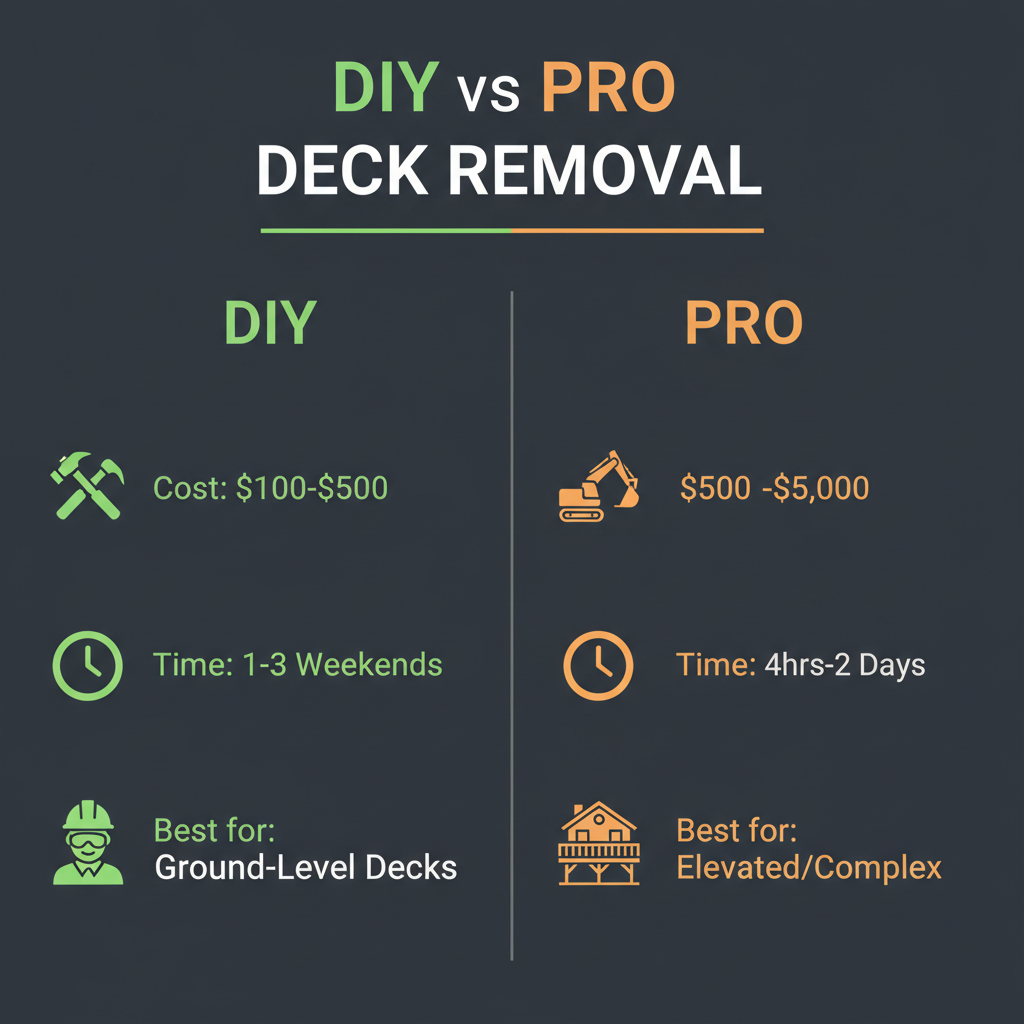
When to DIY: Ground-level wood decks under 300 square feet are the sweet spot for DIY deck demolition. The deck boards pry up with a flat bar, joists cut with a reciprocating saw, and the whole thing loads into a rented dumpster over a weekend. You'll need proper tools and safety gear — work gloves, safety glasses, and steel-toed boots are non-negotiable. The wood is full of nails and screws, and cut lumber has sharp edges. Budget $300–$500 for a dumpster and you'll save $500–$2,000 in labor compared to hiring a crew.
When to hire a pro: Any deck more than 3–4 feet off the ground, multi-level decks, decks with extensive concrete footings, decks attached to the house where the ledger board removal needs to be done properly, and any deck where structural integrity is questionable. The fall risk on elevated deck demolition is real — a professional crew has the experience, insurance, and proper tools and safety gear to handle it efficiently. A deck collapse during amateur demolition can cause serious injury.
The Deck Removal Process
Step 1: Clear the deck. Remove all furniture, planters, grills, and decorations. Disconnect any electrical fixtures (post lights, outlet covers). If the deck has a gas line for a built-in grill, have it professionally disconnected and capped.
Step 2: Remove railings and stairs. Start with the railings — they're typically screwed or bolted to the deck posts. Remove balusters, then rail sections, then posts. Stairs come next. Work from the top down on elevated decks.
Step 3: Remove deck boards. Pry up deck boards starting from one edge. If the boards are screwed down, back the screws out with a drill — it's faster and cleaner than prying. If they're nailed, a flat pry bar works board by board. Cut boards into 4–6 foot sections for easier handling and dumpster loading. Stack as you go rather than letting them scatter.
Step 4: Remove joists and beams. With the decking gone, the joist structure is exposed. Cut joists free from the ledger board and rim joist with a reciprocating saw. Remove beams from their post connections. On elevated decks, work carefully — the structure loses stability as you remove framing members.
Step 5: Remove posts and footings. Support posts are typically attached to concrete footings with post brackets or set directly in concrete. Dig around the footing, then rock and pull it out. For deep footings (36"+ below grade), you may need to dig with a post hole digger or rent a small excavator. Some homeowners leave footings in place and cut the posts flush with grade — this is acceptable if you're landscaping over the area.
Step 6: Address the ledger board area. If the deck was attached to the house, remove the ledger board and inspect the rim joist and sheathing behind it for water damage or rot. Repair any damage, install new house wrap or flashing, and reinstall siding. This step is critical — an improperly sealed ledger area is the number one source of water damage on homes with deck history.
Step 7: Haul debris and cleanup. Load all lumber, hardware, and concrete into the dumpster or onto a truck. Rake the area clean. Grade if needed. If the deck was over a landscaped area, assess whether the ground underneath needs restoration — years of shade and drip patterns usually leave bare or compacted soil that needs topsoil and reseeding.
Tips to Reduce Deck Removal Costs
Get multiple quotes. Deck removal pricing varies significantly between junk removal companies, demolition contractors, and handyman services. Get at least three bids. The spread is often 40–60% — the cheapest bid saves real money.
Remove the decking yourself. Even if you hire a pro for the structural demo, pulling up the deck boards yourself reduces the labor scope. Deck board removal is the easiest part of the job — it's tedious but not technically difficult. This partial DIY approach can save 20–30% on the total cost.
List usable lumber for free. If the deck boards and framing are in decent condition, post them for free pickup on Craigslist or Facebook Marketplace. Many people want free lumber for garden projects, fencing, or workshop builds. This saves you disposal costs and keeps usable material out of the landfill.
Leave the footings. If you're not building a new structure on the same spot, consider leaving the concrete footings in place and cutting the posts flush with grade. Footing removal typically costs $50–$150 per footing — on a deck with 8–12 footings, that's $400–$1,800 saved. Cover the cut posts with soil and landscape over them.
Salvage composite decking. Composite deck boards in good condition have resale value. They're expensive new ($3–$8 per linear foot), so used boards at half price sell quickly. Remove them carefully with a drill rather than prying, and you can list them for sale.
Schedule in the off-season. In many markets, late fall and winter are slower for outdoor demolition. You can often negotiate 10–15% lower pricing when contractors are less busy.
Common Reasons for Deck Removal
Understanding why decks get removed helps you assess whether removal is the right choice for your situation:
Structural failure or safety concerns. Decks older than 20–25 years may have significant rot, loose railings, or compromised support posts. If repair costs approach 50% or more of replacement cost, removal and rebuilding is usually the better investment.
Replacing with a new deck. Removing the old deck to build a new one in the same or a different footprint. Many homeowners upgrade from pressure-treated wood to composite decking, or change the deck layout entirely.
Converting to a patio. Some homeowners prefer a low-maintenance concrete or paver patio over a wood deck. Removing the deck and its footings creates a clean slate for the new hardscape.
Selling the property. A deteriorating deck is a liability and an eyesore that can reduce property value. Removing a bad deck is sometimes better for resale than leaving it — buyers see a maintenance problem rather than an outdoor space.
Landscape redesign. Reclaiming the footprint under an old deck for garden space, a pool area, or expanded yard. The ground under a long-standing deck usually needs significant restoration before it's usable.
FAQ
How much does it cost to remove a deck?
Deck removal costs range from $500 to $5,000 for most residential projects. A small ground-level wood deck (under 150 sq ft) costs $300–$1,000. A medium deck (150–300 sq ft) runs $1,000–$2,500. Large elevated or multi-level decks can cost $2,500–$5,000+. Concrete footing removal adds $300–$1,000 to the project.
How much does it cost to demo a 20x20 deck?
A 20×20 deck (400 sq ft) typically costs $1,500–$4,000 for professional removal including debris hauling. Ground-level wood decks fall on the lower end of that range. Elevated decks with stairs, railings, and concrete footings cost more. DIY removal of a 20×20 deck runs $200–$600 for dumpster rental and disposal only.
Do I need a permit to remove a deck?
In many jurisdictions, yes — especially for elevated decks attached to the house. Ground-level freestanding decks under a certain size may be exempt. Permit fees range from $50–$300. Some areas require post-demolition inspection of the ledger board area. Check with your local building department before starting.
How long does professional deck demolition take?
A professional crew can remove a small to medium deck (under 300 sq ft) in 4–8 hours including cleanup. Large or elevated decks take 1–2 full days. Multi-level decks with extensive footings can take 2–3 days. DIY deck removal typically takes a full weekend for a medium-sized project.
Can I remove my own deck?
Yes — ground-level wood decks are common DIY demolition projects. You'll need a reciprocating saw, pry bar, drill, and a rented dumpster. Elevated decks (more than 3–4 feet off the ground) should be left to professionals due to fall risk and structural collapse potential during the demolition process.
What should I do with old deck boards?
Options include listing usable lumber for free pickup on Craigslist or Facebook Marketplace, donating to Habitat for Humanity ReStore, repurposing boards for garden beds or fencing, hauling to the landfill, or renting a dumpster. Note that pressure-treated lumber cannot be burned — it contains chemical preservatives that release toxic fumes.
What are the risks of DIY deck removal?
The primary risks are structural collapse (especially elevated decks), nail and screw injuries, fall hazards on multi-level decks, and heavy lifting injuries from carrying lumber. Decks attached to the house require careful removal at the ledger board to avoid damaging the siding or creating water intrusion points that lead to rot.
Related Calculators
Planning a larger outdoor renovation? These calculators help estimate costs for related projects:
- Concrete Demolition Cost Calculator — Patio slab and footing removal
- Shed Removal Cost Calculator — Outbuilding teardown
- Garage Demolition Cost Calculator — Attached and detached garage removal
- House Demolition Cost Calculator — Full residential teardown
- Demolition Permits Guide — Permit requirements by state
Data Sources & Methodology
This calculator estimates deck removal costs based on: deck type and material (wood, composite, concrete), size (square footage), height above ground, attachment method, footing count, and state-specific labor and disposal rates across all 50 US states.
Cost ranges are compiled from contractor bid data, junk removal company pricing surveys, Bureau of Labor Statistics wage data, and regional landfill tipping fee databases. Figures are validated against published pricing from HomeGuide, Angi, and local demolition contractor surveys. Updated quarterly.