What Is a Pool Demolition Cost Calculator?
A pool demolition cost calculator estimates what it costs to remove a swimming pool from your property. It covers excavation, backfill, debris disposal, and site restoration — adjusted for your pool type, removal method, and state.
Whether you're looking at a straightforward above-ground removal for a few hundred dollars or a full inground concrete pool excavation that can run $4,000–$16,000, the variables that drive cost are surprisingly specific to your situation. Pool material, removal method, and your state's labor market matter far more than most homeowners expect going in.
This calculator also helps you estimate inground pool removal pricing, above ground pool teardown costs, pool fill-in vs full removal analysis, swimming pool demolition budgeting, and backfill and landscaping restoration — all using state-specific labor and disposal data.
Pool removal is one of those projects where the price range is wide enough to be confusing. A homeowner who walks in knowing the difference between partial fill-in and full removal — and what each costs in their state — will make a fundamentally better decision.
How Much Does Pool Demolition Cost in 2025–2026?
Pool demolition costs depend primarily on three factors: pool type (above ground vs inground), pool material (concrete, fiberglass, vinyl), and removal method (partial fill-in vs full excavation). The range is substantial.
| Pool Type | Partial Fill-In | Full Removal | Notes |
|---|---|---|---|
| Above Ground | $300 – $800 | $800 – $2,500 | Simplest removal |
| Inground Vinyl | $2,000 – $5,000 | $4,000 – $10,000 | Liner + frame removal |
| Inground Fiberglass | $2,500 – $6,000 | $5,000 – $12,000 | Shell removal required |
| Inground Concrete | $3,000 – $10,000 | $5,000 – $16,000 | Most labor-intensive |
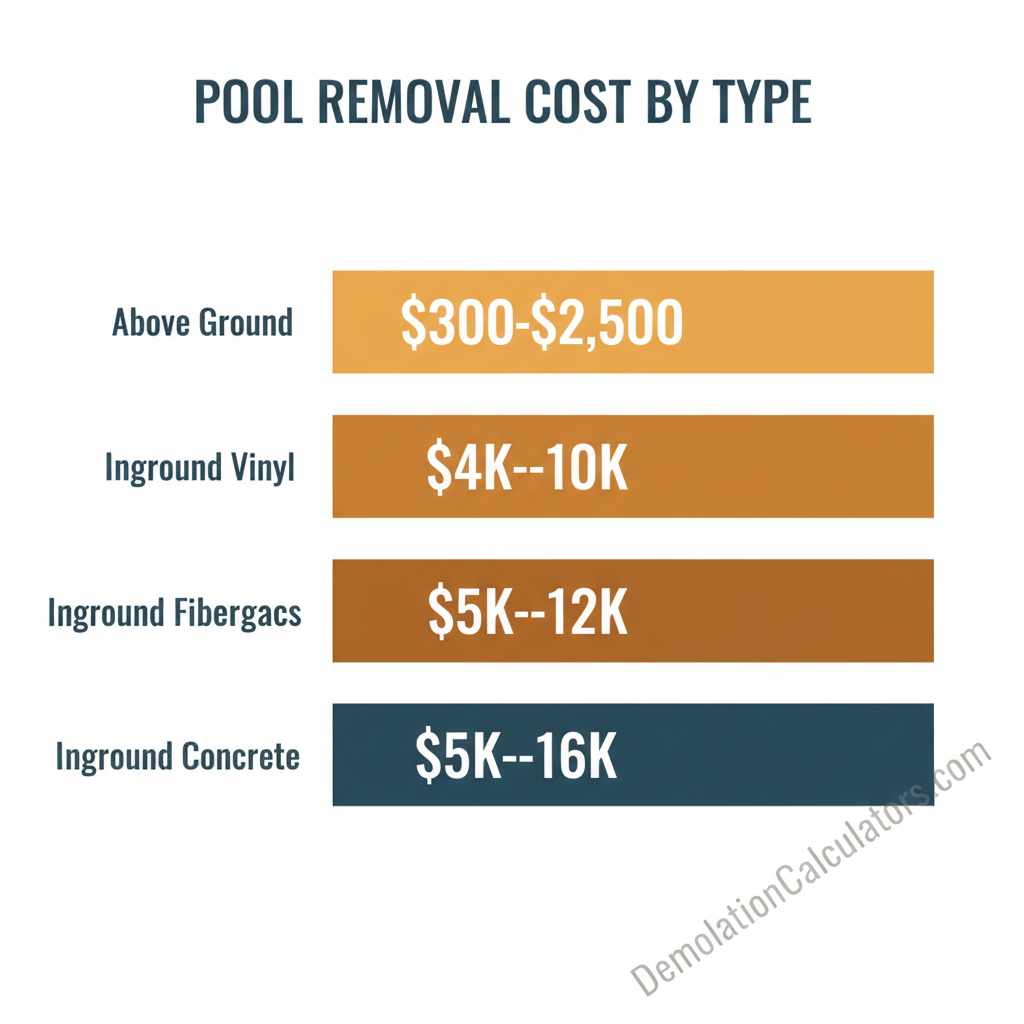
📊 Key Insights from the Data:
Above-ground pools are in a completely different cost category. Disassembly and removal is a straightforward project — often a weekend job for a contractor or even a capable DIYer. The cost is primarily labor and disposal for the metal or resin frame components.
Inground concrete pools are the expensive scenario, and the reason is physics. Concrete doesn't come apart easily. Breaking up a gunite or shotcrete pool shell requires hydraulic breakers, generates heavy debris, and produces disposal volumes that smaller pools don't. A 400 sq ft concrete pool can generate 30–50 cubic yards of debris — at disposal rates ranging from $38–$90/cubic yard depending on your state, that's $1,140–$4,500 just for hauling.
The partial vs full removal decision is the single biggest cost lever. Partial fill-in costs roughly 40–60% less than full excavation. But it comes with a trade-off: partial removal can affect future buildability and must be disclosed to future buyers in most states.
State labor rates shift every number in the table. An inground concrete pool removal that costs $5,000 in low-cost Southern markets can run $12,000–$16,000 in California or Hawaii. The pool is the same; the labor market is not. Contractors will almost always recommend full removal if they know you're planning to sell — and there's a reason for that.
🔍 Quick Comparison:
- Above ground removal is a $300–$2,500 project regardless of location
- Inground partial fill-in saves 40–60% over full removal but limits future use
- Inground full removal is required if you plan to build on the site
- Concrete pools cost 30–60% more to remove than vinyl or fiberglass due to material density
👉 Concrete demolition pricing — for standalone slab and concrete removal estimates
Partial vs Full Pool Removal: Which Should You Choose?
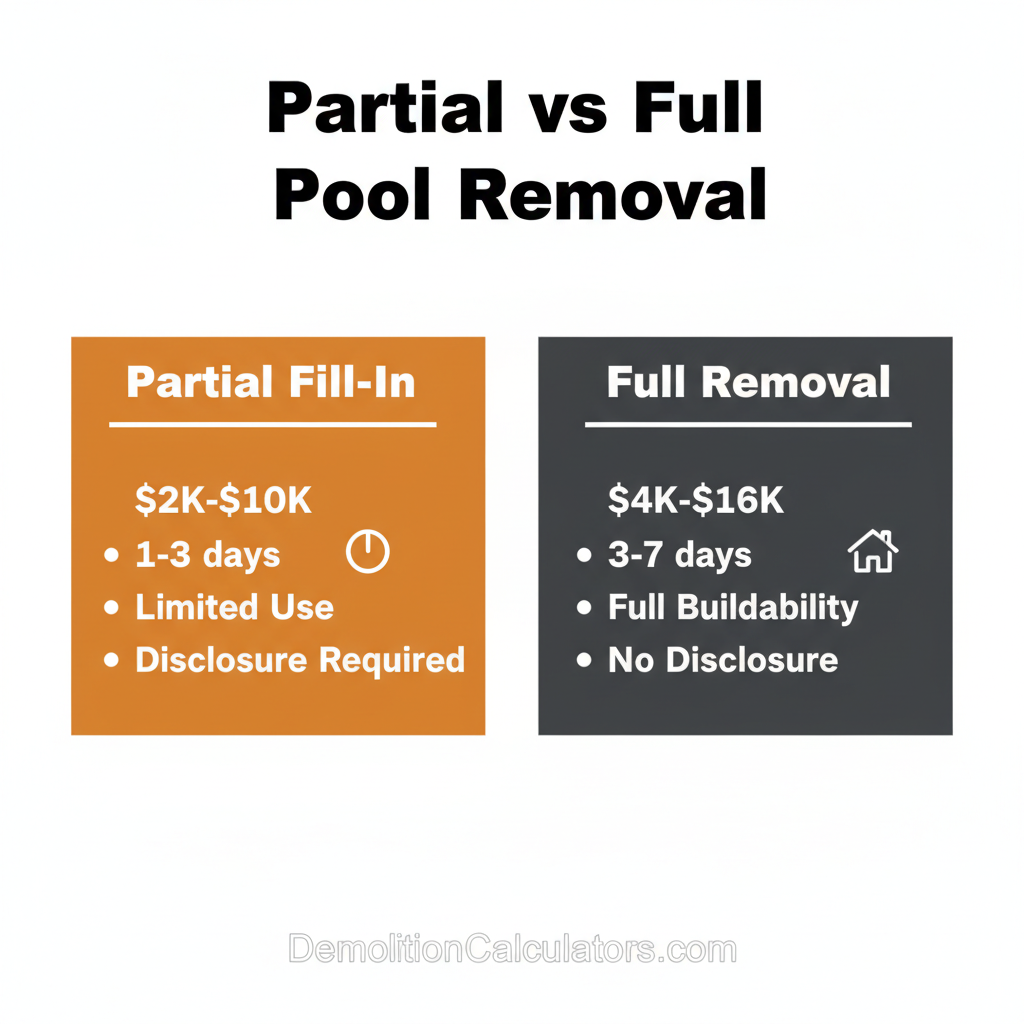
This is the most important decision in any pool demolition project — and the cost difference is significant enough to warrant careful consideration.
| Factor | Partial Fill-In | Full Removal |
|---|---|---|
| Cost | $2,000 – $10,000 | $4,000 – $16,000 |
| Timeline | 1–3 days | 3–7 days |
| Future buildability | Limited — settling risk | Full — build anything |
| Disclosure required | Yes (most states) | No |
| Best for | Cost savings, no future building plans | Selling, rebuilding, or redevelopment |
| Drainage | Must punch holes for water passage | Complete removal eliminates issue |
Partial fill-in works well when you simply want to eliminate the pool and restore the yard. The contractor breaks the upper portion of the pool walls (typically 18–36 inches below grade), punches holes in the floor for drainage, collapses the remaining walls inward, and backfills with clean fill dirt compacted in layers. Total cost runs 40–60% less than full removal.
The catch: most states require seller disclosure of a filled-in pool. Some buyers — and some builders — won't touch a lot with a partially filled pool due to settling risk. If you're removing the pool to sell the property or to build on that footprint, full removal is the safer investment.
Why this matters: The $3,000–$6,000 you save on partial fill-in can evaporate if a future buyer discounts your property by $10,000 because of the disclosure. Think about your 3-5 year plan for the property before choosing.
👉 House demolition estimates — if you're considering full property teardown alongside pool removal
How Our Pool Demolition Cost Calculator Works
Our calculator estimates pool removal costs using a multi-factor approach calibrated with BLS labor data and state disposal rates:
1. Pool Type & Material
The material determines equipment needs and debris volume. Concrete pools require hydraulic breakers. Fiberglass may need crane removal for large shell sections. Vinyl pools are the simplest to demolish. Above-ground pools are primarily disassembly jobs.
2. Pool Size
Larger pools mean more material to remove and more debris to dispose of. Costs don't scale perfectly linearly — mobilization, permitting, and equipment costs are partially fixed regardless of pool size.
3. Removal Method
Partial fill-in applies a 0.6× multiplier to the base cost. Full removal uses the full base cost. This single choice represents the largest controllable cost variable in the project.
4. State Labor & Disposal Rates
BLS wage data and state landfill tipping fees adjust every estimate to local market conditions. The same concrete pool removal that costs $5,000 in affordable Southern markets runs $12,000+ in premium states.
5. Additional Scope
Deck removal, fence removal, and landscaping restoration add to the base pool demolition cost. A pool with a 400 sq ft concrete deck and aluminum fence can add $3,000–$7,000 to the total.
👉 Deck removal estimates — for pool deck demolition pricing
Factors That Affect Pool Demolition Cost
1. Pool Material
Concrete is the most expensive to remove — hard to break, heavy to haul. Fiberglass is lighter but awkward to extract in sections. Vinyl liner pools are the simplest. The material alone can create a 2–3× cost difference between pool types of the same size.
2. Pool Size and Depth
Deeper pools mean more backfill material. A pool with a 9-foot deep end requires significantly more fill than a uniform 4-foot depth — and engineered fill costs $15–$30 per cubic yard delivered.
3. Access to the Pool
Equipment access is a major cost driver that's hard to assess without seeing the property. If an excavator can drive into the backyard, the job goes smoothly. If equipment must work over fences or through narrow side yards, costs increase 20–40%. This is the factor that most frequently causes actual costs to exceed calculator estimates.
4. Surrounding Structures
Pool decks, coping, fencing, and equipment pads all add to the demolition scope. A pool with a 500 sq ft stamped concrete deck adds $2,000–$5,000 in deck removal alone.
5. Plumbing and Electrical
Pool plumbing lines and electrical conduit must be properly capped or removed. This typically adds $500–$1,500 depending on complexity. Gas-heated pools add a gas line disconnection step.
6. Permits
Pool demolition permits range from $100 to $500. Some jurisdictions require a soil compaction test after backfill — an additional $300–$500.
👉 Demolition permit costs — for state-by-state permit fee estimates
7. Backfill Material
Clean fill dirt costs $15–$30 per cubic yard delivered. A full-removal project on a 400 sq ft pool with an 8-foot deep end might require 50+ cubic yards of fill — $750–$1,500 in material alone.
8. Disposal Fees
Concrete pool debris is heavy. Disposal rates of $38–$90/cubic yard apply, and a large concrete pool can generate 30–50 cubic yards. This makes disposal a $1,100–$4,500 line item — often the second-largest cost component after labor.
Pool Demolition Cost by State
Pool Removal Cost in Low-Cost Markets (Mississippi, Arkansas, Alabama)
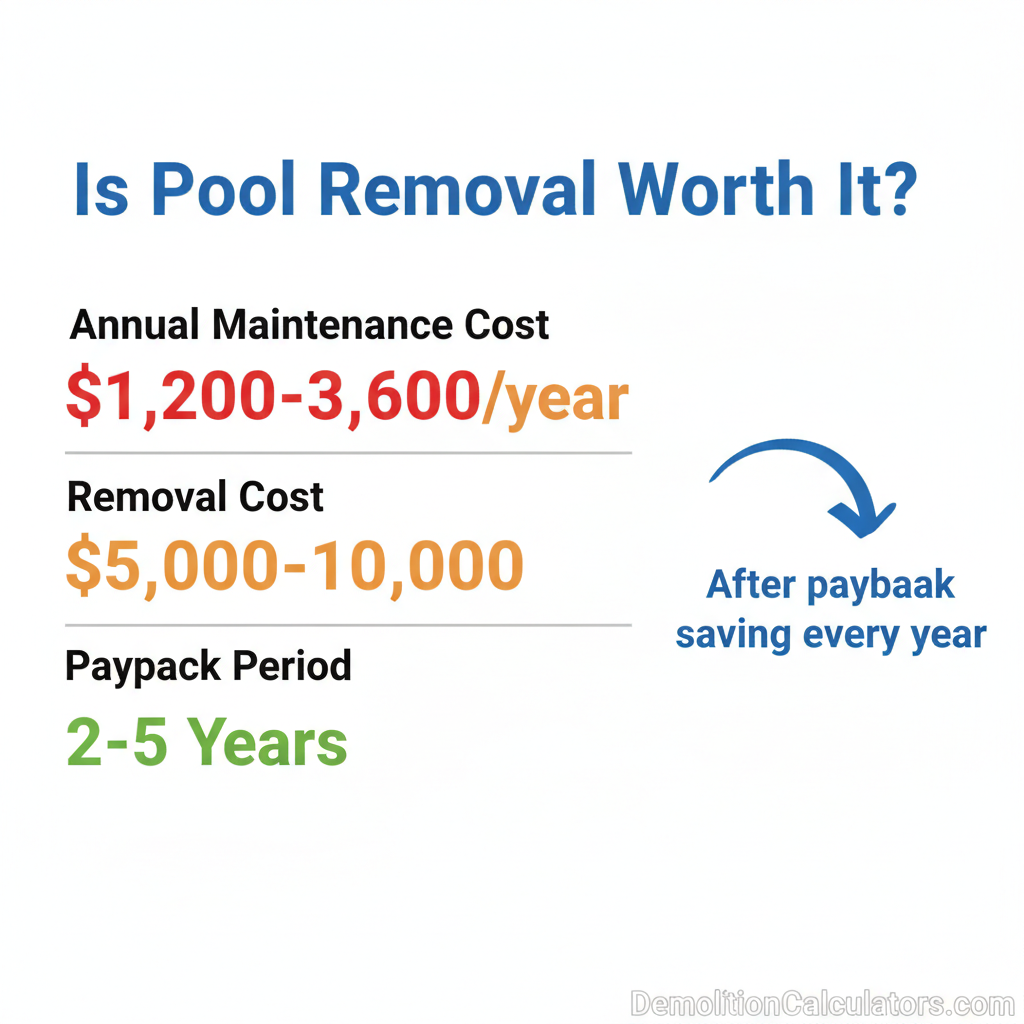
Market Profile: Most affordable. With labor at $32–$35/hour and disposal under $45/cubic yard, inground concrete pool removal runs $4,000–$10,000 for full removal. Partial fill-in drops to $2,000–$5,000. These are the markets where the cost-benefit of pool removal is clearest — when annual pool maintenance runs $1,200–$3,600, the payback period on removal can be under 3 years.
Pool Removal Cost in Mid-Range Markets (Texas, Florida, Ohio)
Market Profile: National average range. Full removal costs $5,000–$13,000. Florida is notable because pool density is among the highest nationally — which means more experienced contractors and competitive pricing. Texas follows its usual pattern: affordable in rural areas, premium in metro suburbs.
Pool Removal Cost in Premium Markets (California, New York, Hawaii)
Market Profile: Regulation and labor premium. Full removal runs $8,000–$16,000+. California adds environmental compliance requirements for pool demolition debris. Hawaii's isolation premium applies just as it does to every other construction trade.
How Accurate Is an Online Pool Demolition Cost Calculator?
Typical Accuracy Range: Our calculator provides 80–90% accuracy for standard pool removals. Pool demolition is actually one of the more predictable demolition categories because the scope is relatively contained.
When accuracy is highest: Standard inground pools in suburban settings with good equipment access, in states with stable contractor markets.
When accuracy may vary: Pools with extensive surrounding structures, properties with difficult equipment access, or concrete pools with unusual construction.
| Factor | Online Calculator | Professional Quote |
|---|---|---|
| Speed | Instant | 3–5 days |
| Cost | Free | Free |
| Site inspection | No | Yes |
| Accuracy | 80–90% | 95%+ |
| Best for | Initial budgeting | Final commitment |
Important Note: The biggest gap between calculator estimates and actual quotes comes from access constraints. If your pool is behind a house with a narrow side yard, expect actual costs 20–40% above the calculator estimate.
Frequently Asked Questions About Pool Demolition Cost
How much does it cost to remove an inground pool?
Inground pool removal costs $2,000–$16,000 depending on material, size, removal method, and location. Partial fill-in runs $2,000–$10,000. Full removal costs $4,000–$16,000. Concrete pools are most expensive; vinyl is least.
How much does above ground pool removal cost?
Above-ground pool removal typically costs $300–$2,500 including disassembly, disposal, and basic site cleanup. It's the most affordable pool demolition category and sometimes feasible as a DIY project.
Is partial fill-in cheaper than full pool removal?
Yes — partial fill-in costs approximately 40–60% less. However, it requires seller disclosure in most states and can affect lot buildability. Full removal eliminates these concerns entirely.
Do I need a permit to remove a pool?
Most municipalities require a demolition permit for inground pool removal, typically $100–$500. Some also require a soil compaction test after backfill. Your contractor handles permitting as part of their scope.
Can I build on a filled-in pool?
After full removal with proper engineered backfill — yes. After partial fill-in — it depends. Settling risk exists, and many builders won't pour a foundation over a partially filled pool.
How long does pool demolition take?
Above-ground: 1 day. Inground partial fill-in: 1–3 days. Full inground removal: 3–7 days. Add time for permits and inspections.
Does removing a pool increase property value?
It depends on the market. In pool-desirable areas (Florida, Arizona), removal might decrease value. In markets where pools are seen as maintenance burdens, removal can widen the set of interested buyers.
What happens to the pool equipment?
Pumps, filters, heaters, and plumbing are removed as part of demolition. Electrical is disconnected and capped by a licensed electrician. Working equipment can sometimes be sold to offset costs.
Related Demolition Calculators You Might Need
- House Demolition Cost Calculator – Full residential teardown from $6,000–$25,000
- Concrete Demolition Cost Calculator – Pool deck and surrounding concrete removal
- Deck Demolition Cost Calculator – Pool deck removal at $5–$15/sq ft
- Garage Demolition Cost Calculator – Attached and detached garage teardown
- Bathroom Demolition Cost Calculator – Interior renovation demo estimates
- Demolition Permit Cost Calculator – State-by-state permit fees
Data Sources & Methodology
- 🏛️ Bureau of Labor Statistics (BLS) – Wage data for demolition and excavation trades by state
- 📊 State Environmental Agencies – Landfill tipping fees and C&D disposal rates
- 🏢 Municipal Building Departments – Pool demolition permit fee schedules
- 📈 Industry Surveys – Aggregated pricing from pool demolition contractors nationwide
Update Frequency: Quarterly with BLS wage releases. Figures reflect 2025–2026 market conditions.