How long does demolition take?
The demolition itself is often the fastest part. A kitchen gut takes 1–2 days, a house teardown takes 1–5 days, and a shed comes down in 2–8 hours. The real timeline extends when you factor in permits (3–14 days), utility disconnection (1–2 weeks), and hazardous material abatement (1–3 weeks).
Understanding the Demolition Process
Most people think of demolition as the dramatic part — the excavator tearing through walls, the wrecking ball swinging. But the actual teardown is typically the shortest phase of a demolition project. The timeline is dominated by what happens before and after: permits, inspections, utility disconnection, hazardous material testing and abatement, debris removal and disposal, and site grading.
Understanding the full demolition timeline helps you plan your construction schedule, coordinate with contractors, and avoid the most common delay: assuming the process takes days when it actually takes weeks.
Typical Demolition Timeline by Project Type
Here's how long each type of demolition project takes — from initial planning through final cleanup:
| Project Type | Demo Time | Total Project Time | Biggest Delay |
|---|---|---|---|
| House (small, wood-frame) | 1–2 days | 2–4 weeks | Permits + asbestos |
| House (large, brick/concrete) | 3–5 days | 3–6 weeks | Foundation removal + abatement |
| Kitchen gut | 1–2 days | 1–2 weeks | Asbestos testing (pre-1980 homes) |
| Bathroom gut | 1 day | 1–2 weeks | Plumbing coordination |
| Garage (detached) | 1–2 days | 1–3 weeks | Permits + slab removal |
| Barn | 1–3 days | 2–4 weeks | Salvage/deconstruction time |
| Shed | 2–8 hours | 1–3 days | Dumpster scheduling |
| Deck | 4 hrs–2 days | 1–2 weeks | Footing removal + permits |
| Pool | 2–5 days | 2–4 weeks | Permits + backfill settling |
| Full interior gut | 3–7 days | 2–4 weeks | Asbestos + lead paint |
| Concrete slab/driveway | 1–2 days | 3–7 days | Rebar adds time |
| Commercial building (small) | 1–2 weeks | 4–8 weeks | Plan review + environmental |
| Commercial building (large) | 2–8 weeks | 2–6 months | Structural engineering + phased demo |
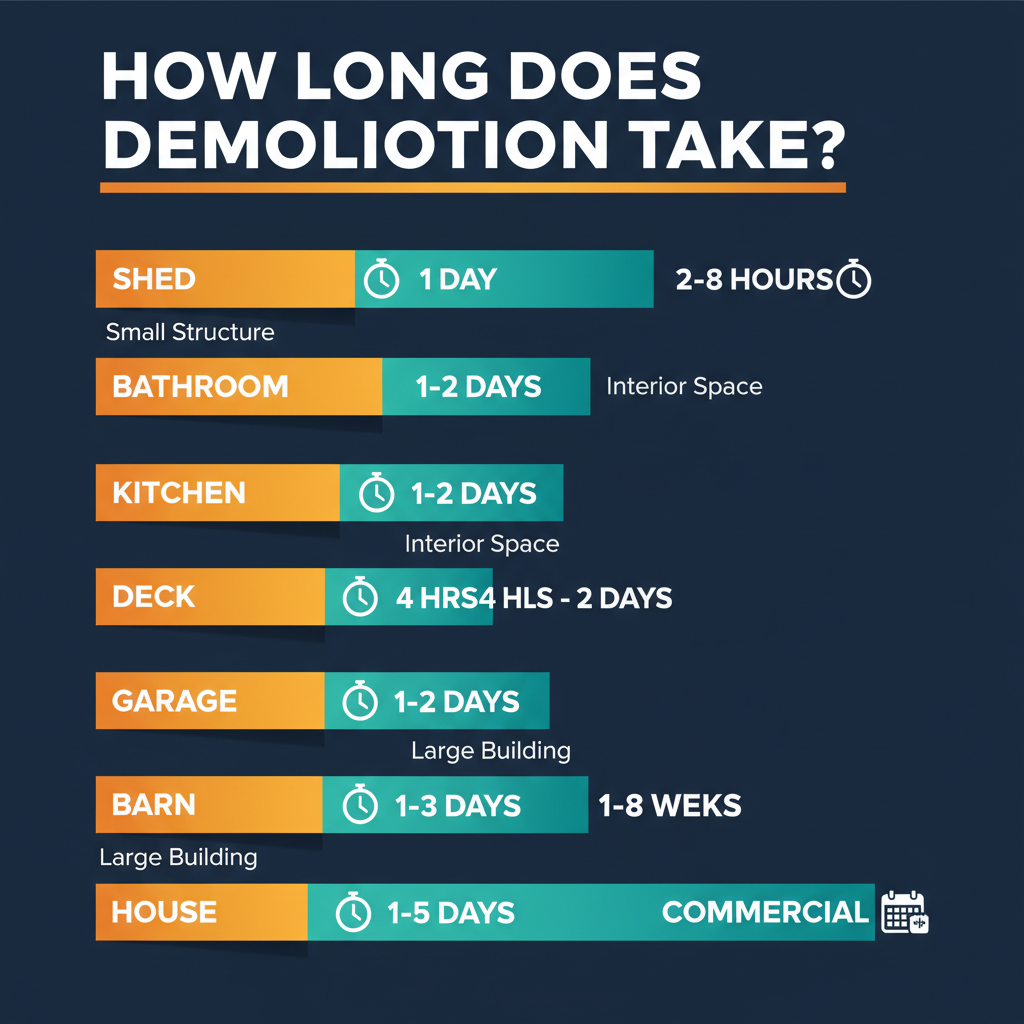
The pattern is consistent across every project type: the physical demolition is fast, but the process around it is slow. A house that takes 2 days to tear down takes 4 weeks as a complete project because of the permit, utility, and abatement lead time.
Steps in the Demolition Process: A General Timeline
Every demolition project — whether it's a small shed or a full house — follows the same basic sequence. The steps scale in complexity, but the order is universal.
Phase 1: Planning and Permits (1–4 weeks)
This is where most of the calendar time lives. You need to apply for a demolition permit (3–14 business days for residential, 2–4 weeks for commercial). Schedule utility disconnection — electric, gas, water, sewer, cable — which requires 1–2 weeks of lead time with each provider. If the structure was built before 1980, schedule hazardous material testing for asbestos, lead paint, and other regulated materials. Testing takes 2–3 days for results. If hazardous materials are found, licensed abatement must be completed before demolition begins — this alone can add 1–3 weeks.
Phase 2: Site Preparation (1–2 days)
Before the demolition crew arrives, the site needs to be ready. This includes fencing or barriers around the work area, tree and landscaping protection, neighbor notification (required in some municipalities), placement of dumpsters or roll-off containers, and final utility disconnect verification. For commercial demolition projects, this phase also includes traffic control planning, structural engineering review, and detailed demolition sequencing.
Phase 3: Salvage and Selective Demolition (0–14 days)
If you're salvaging materials — reclaimed wood from a barn, cabinets from a kitchen, or fixtures from a bathroom — this happens before the heavy demolition begins. Manual deconstruction for salvage takes significantly longer than mechanical demolition. A barn that would take 1–3 days to demolish mechanically might take 1–3 weeks to deconstruct if you're preserving the timber frame. This phase is optional but can add significant time to the project when salvage is part of the plan.
Phase 4: The Demolition (hours to weeks)
This is the part most people picture when they think about demolition. An excavator with a grapple attachment tears through a wood-frame house in 1–2 days. A bathroom gut takes a crew 4–8 hours. A large commercial building demolition can take weeks of systematic, floor-by-floor teardown. The demolition method matters too — mechanical demolition with heavy equipment is fastest, manual demolition is slowest, and selective demolition (preserving certain elements while removing others) falls somewhere in between.
Phase 5: Debris Removal and Disposal (1–3 days)
After the structure comes down, the debris needs to be loaded, hauled, and disposed of. A small residential demolition might fill one or two dumpsters. A full house teardown generates 30–60 cubic yards of waste requiring multiple truck loads. Sorting debris for recycling (concrete, metal, clean wood) takes longer but reduces landfill disposal costs. The debris removal timeline depends on the volume of material, the distance to the disposal facility, and whether the demolition contractor owns their own hauling equipment or needs to coordinate with a separate hauling company.
Phase 6: Foundation Removal and Site Grading (1–5 days)
If the demolition includes foundation removal, this is a separate phase requiring different equipment (a breaker attachment for the excavator). Concrete foundations take 1–3 days to break up and remove depending on thickness and rebar reinforcement. After the foundation is out, the site needs grading — leveling the ground, filling depressions, and preparing the surface for whatever comes next (new construction, landscaping, or simply a clean lot). Topsoil application and seeding adds another day.
Phase 7: Final Inspection and Permit Closure (1–3 days)
Most jurisdictions require a final inspection after demolition is complete. The inspector verifies the site has been properly cleared, graded, and secured. Once approved, the demolition permit is closed. Don't skip this step — an open permit creates complications with future property sales and new construction permits.
Factors That Affect Demolition Timeline
Structure Size and Material
A 1,000 sq ft wood-frame house comes down in 1–2 days. A 3,000 sq ft brick house takes 3–5 days. Concrete and steel structures take the longest because the material is harder to break apart and heavier to haul. Size scales roughly linearly — twice the square footage means roughly twice the demolition time, plus additional time for the proportionally larger volume of debris.
Hazardous Materials
Asbestos and lead paint are the biggest schedule killers in residential demolition. Testing takes 2–3 days. If confirmed, licensed abatement must happen before any demolition work begins. Asbestos abatement can take anywhere from 1 day (limited to a few pipe wraps) to 2–3 weeks (extensive asbestos siding, floor tile, and insulation). Homes built before 1980 should always be tested before demolition begins — discovering hazardous material after the project has started creates costly work stoppages.
Permit Processing Time
Residential demolition permits take 3–14 business days in most jurisdictions. Commercial permits can take 2–4 weeks or more due to plan review requirements. Properties in historic districts face the longest delays — historical commission review can add 30–90 days to the permit timeline. Expedited processing is available in some jurisdictions for an additional fee.
Weather
Rain, snow, and frozen ground all slow demolition work. Heavy equipment can't operate safely on saturated soil — the excavator gets stuck, truck access is compromised, and the site becomes a mud pit. Frozen ground makes foundation removal and grading significantly harder. In many markets, scheduling demolition during dry weather months (late spring through early fall) keeps the project on timeline.
Site Access and Location
A structure with easy road access and open space around it comes down faster than one in a tight urban lot surrounded by neighboring buildings. Poor access means smaller equipment, more hand labor, and slower debris hauling. Multi-story buildings in dense urban areas may require partial street closures, which adds permitting time and traffic control logistics.
Demolition Method
Mechanical demolition with an excavator is the fastest method — a skilled operator can bring down a residential structure in hours. Manual demolition (deconstruction) is the slowest, taking 5–15 times longer, but preserves salvageable materials. Selective demolition falls in between — the crew carefully removes specific elements before bringing in heavy equipment for the rest. The method is usually dictated by the project goals, site constraints, and whether material salvage is a priority.
Contractor Availability
Demolition contractors are busiest from late spring through early fall. During peak season, you may wait 2–4 weeks just to get on a contractor's schedule before the work begins. In the off-season (late fall and winter), contractors are more available and work can start sooner — though weather may add delays on the other end.
How to Speed Up the Demolition Process
Start paperwork early. Apply for the demolition permit and schedule utility disconnects the moment you've committed to the project. These are the two longest lead-time items, and both can run in parallel while you're getting bids and selecting a contractor.
Test for hazardous materials immediately. Don't wait until the contractor is ready to start. Schedule asbestos and lead paint testing during the planning phase. If abatement is needed, it can run concurrently with the permit process rather than sequentially — potentially saving 1–2 weeks.
Choose a full-service demolition contractor. A demolition company that handles permits, abatement coordination, demolition, hauling, and grading as a single scope of work moves faster than coordinating three or four separate contractors. One point of contact, one schedule, fewer handoff delays.
Have dumpsters and hauling pre-arranged. Debris removal is a common bottleneck. If the dumpster company can't deliver on the day demolition finishes, the site sits idle until hauling catches up. Book dumpster rental or hauling services before demo day — not after.
Clear the structure before the crew arrives. For interior demolition, remove all furniture, personal belongings, and stored items before the demo crew shows up. For exterior structures, clear landscaping, remove fencing, and ensure the driveway can support heavy equipment. Every hour the crew spends on prep is an hour not spent on demolition.
Schedule during dry weather. Weather delays are unpredictable but avoidable with timing. If your project allows flexibility, schedule for a dry stretch. Check the extended forecast before confirming the start date.
Residential vs. Commercial Demolition Timelines
Residential and commercial demolition projects follow the same basic process, but the timelines differ dramatically due to scale, complexity, and regulatory requirements.
| Factor | Residential | Commercial |
|---|---|---|
| Permit timeline | 3–14 business days | 2–8 weeks |
| Environmental review | Asbestos/lead testing (2–3 days) | Phase I/II ESA (2–6 weeks) |
| Demolition time | 1–5 days | 1–8 weeks |
| Debris volume | 30–100 cubic yards | 500–10,000+ cubic yards |
| Total project | 2–6 weeks | 1–6 months |
| Primary delay | Permits + abatement | Environmental + plan review |
Commercial demolition projects also involve structural engineering review (for buildings over 3 stories), OSHA compliance documentation, traffic control and public safety planning, and often phased demolition where sections of a building are taken down in sequence rather than all at once. A large commercial building demolition can take several months from planning to completion.
What Can Slow Down a Demolition Project?
Unexpected hazardous materials. Discovering asbestos or lead paint after demolition has started triggers an immediate work stoppage. The site must be secured, testing completed, and licensed abatement performed before work can resume. This is the most expensive delay because you're paying for a crew and equipment to sit idle. Pre-demolition testing eliminates this risk.
Permit delays. If your application is incomplete, requires revisions, or triggers a historical review, the permit timeline can extend by weeks or months. Submit a complete application with all required documentation the first time.
Utility companies. Utility disconnection is rarely urgent for the utility company. They schedule it when it's convenient for their crews, not yours. Start the disconnect request early and follow up regularly. A gas line that's still live means the demolition crew cannot start.
Weather. Heavy rain turns a demolition site into an impassable mess. Snow and ice create safety hazards. Frozen ground resists excavation. A week of bad weather during the scheduled demolition window can push the entire project back by 1–2 weeks once the site dries out.
Neighbor objections. In some areas, neighbors can file objections or complaints that trigger additional review. This is more common in historic districts and dense urban neighborhoods. Early communication with neighbors about the timeline, noise expectations, and dust control can prevent formal complaints.
Buried surprises. Underground storage tanks, old wells, septic systems, and buried debris from previous construction can all surface during demolition — literally. Each requires assessment, potential environmental testing, and proper removal before the project can proceed.
FAQ
How long does it take to demolish a house?
A full house demolition typically takes 1–3 weeks from permit to final grading. The demolition itself takes 1–5 days depending on house size and construction type. A small wood-frame house can come down in 1–2 days. A large brick or concrete home takes 3–5 days. Permits, utility disconnection, and asbestos abatement add 1–3 weeks of lead time.
How long does a demolition project take?
Demolition project timelines range from a few hours for a small shed to several months for a large commercial building. Interior demolition (kitchen, bathroom) takes 1–3 days. Exterior structures (deck, garage) take 1–3 days. Full buildings take 1–5 weeks.
Why does demolition take so long?
The actual teardown is often fast — the delays come from the process around it. Permit approval takes 3–14 business days. Utility disconnection takes 1–2 weeks. Asbestos testing and abatement can add 1–3 weeks. The physical demolition is typically the shortest part of the overall project timeline.
How long does it take to demolish a 30x40 house?
A 30×40 foot house (1,200 sq ft) typically takes 1–3 days for the actual demolition with an excavator, plus 1–2 days for foundation removal and site grading. The total project timeline including permits, utility disconnection, and any asbestos abatement runs 2–4 weeks from start to finish.
How can I speed up the demolition process?
Start permits, utility disconnects, and hazardous material testing as early as possible — these are the biggest delays. Schedule during dry weather. Choose a full-service demolition contractor who handles everything in one scope. Have dumpsters and hauling pre-arranged. For DIY interior demo, clear the space of furniture and personal items before starting.
Related Calculators
Estimate costs for your demolition project alongside the timeline:
- House Demolition Cost Calculator — Full residential teardown
- Kitchen Demolition Cost Calculator — Cabinets to full gut
- Bathroom Demolition Cost Calculator — Fixture removal to full strip
- Barn Demolition Cost Calculator — Agricultural structures with salvage
- Deck Demolition Cost Calculator — Wood, composite, and concrete
- Shed Removal Cost Calculator — Small outbuilding teardown
- Commercial Demolition Cost Calculator — Office, warehouse, retail
- Demolition Permits Guide — Fees and timelines by state